
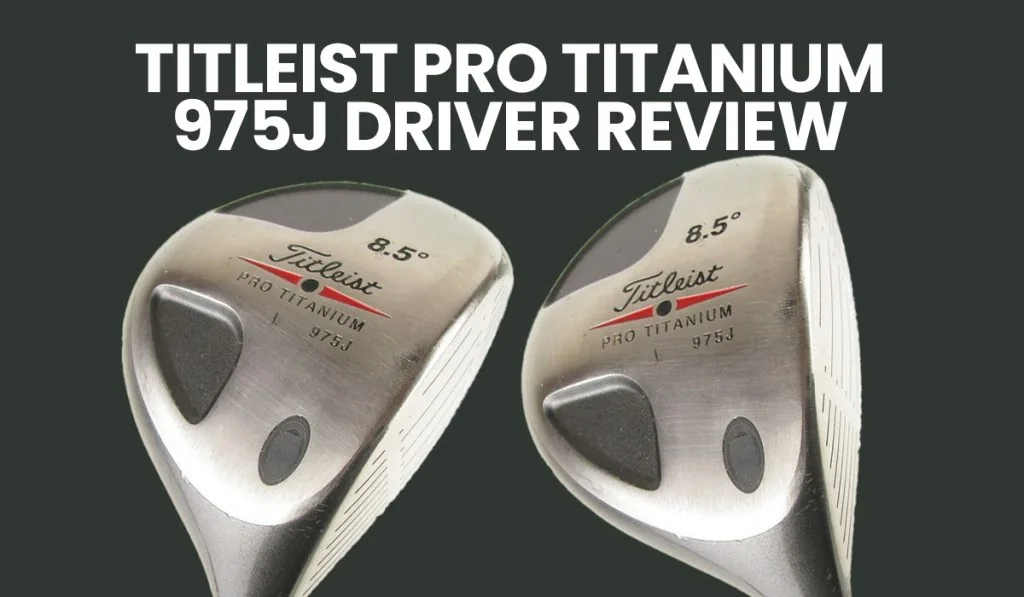
Most people looking up the Titleist Pro Titanium 975J today are deciding whether to buy one second-hand. Short answer: skip it (unless you collect). Below is what the club was in 2001 [1], what has changed since, and who should still consider it.
Is the Pro Titanium 975J worth buying in 2026? Skip it (unless you collect)
It is 25 years old, the loft is fixed, and the head is smaller than today's 460cc standard. Any adjustable driver from the last ten years will be more forgiving and easier to fit.
The Pro Titanium 975J in 2001: what it was
The Pro Titanium 975J was built around a larger, deeper-faced follow-up to the 975D aimed at a wider range of players. It was aimed at better players who wanted a lower, more penetrating flight. We could not confirm its exact head volume from a manufacturer source, so it is not listed.
Then vs now: Pro Titanium 975J vs Titleist GTS4
| Spec | Titleist Pro Titanium 975J | Titleist GTS4 |
|---|---|---|
| Release year | 2001 [1] | 2026 [2] |
| Head size | Not confirmed | 460cc |
| Adjustable hosel | No (glued) | Yes (SureFit) |
| Weighting | — | Low-spin weighting |
| Lofts | See listing (fixed per head) | 8°, 9°, 10° |
| Launch price (new) | — | $699 ($899 premium shaft) |
| Price | Check Price | Check Price |
We list only specs we could tie to a source. A dash means we could not confirm the figure. We do not have our own launch-monitor numbers for either club.
Buying a used Pro Titanium 975J: checklist
- Loft: read the loft stamped on the sole. Because the hosel is glued, that number is final.
- Face: look for cracks, dents or a caved-in look at the centre. A cracked face can't be repaired.
- Crown: sky marks and paint chips are cosmetic; dents are not.
- Shaft and grip: check the flex label. A worn grip costs little to replace; a shaft that is too stiff costs you carry.
- Price check: we could not verify current used prices, so compare recent sold listings before you buy (eBay sold listings).
What Titleist changed after the Pro Titanium 975J
The models below are the Titleist drivers we cover that came after the Pro Titanium 975J. Each one is a step you skip by buying the old club.
| Year | Model | Main change | Prices |
|---|---|---|---|
| 2018 | Titleist TS2 | Speed Chassis: a thinner crown and face that made the TS Titleist's fastest driver at the time | Check Price |
| 2019 | Titleist TS1 | A lightweight build for moderate swing speeds | Check Price |
| 2020 | Titleist TSi2 | An ATI 425 titanium face and a high-MOI shape | Check Price |
| 2021 | Titleist TSi4 | A compact 430cc low-spin head with forward weighting | Check Price |
| 2022 | Titleist TSR3 | SureFit CG track for draw or fade bias | Check Price |
| 2022 | Titleist TSR4 | A 430cc low-spin head | Check Price |
| 2023 | Titleist TSR1 | A lightweight build for moderate swing speeds | Check Price |
| 2026 | Titleist GTS4 | Current model | Check Price |
Showing the 8 most recent steps.
Who should still buy one?
- Buy it if you already hit a low ball flight with enough speed, and you like a compact look.
- Skip it if you can stretch to a recent used model (the last three or four years) — the forgiveness gap is bigger than the price gap.
- Skip it if you need a different loft than the one stamped on the head; it can't be changed.
Check current listings on Amazon
FAQ
When did the Titleist Pro Titanium 975J come out?
2001.
Is the Titleist Pro Titanium 975J still a good driver?
Skip it (unless you collect). It is 25 years old, the loft is fixed, and the head is smaller than today's 460cc standard. Any adjustable driver from the last ten years will be more forgiving and easier to fit.
Is the Pro Titanium 975J adjustable?
No. The hosel is glued, so loft and lie are fixed.
What replaced the Pro Titanium 975J?
Titleist's current equivalent is the Titleist GTS4 (2026). Launch price: $699 ($899 premium shaft).
Sources
- Titleist UK — Previous driver models (official release years)
- Titleist Newsroom — Titleist Introduces NEW GTS Drivers (13 May 2026)