Qi4D vs Qi4D LS specs at a glance
These are TaylorMade's published specs from launch material and product pages. Ball speed, spin and launch are TaylorMade's relative ratings within the Qi4D family, not measured numbers.
Volume note: TaylorMade's spec table lists the Qi4D LS at 460cc, and the Golf Digest Hot List also says it is "still 460cc", while some launch coverage described it as 450cc. Either way it looks smaller and more pear-shaped at address. Prices are US launch prices from January 2026 and may have changed.
Design and technology: same face, different priorities
Both heads use TaylorMade's fifth-generation carbon face, the 60X Carbon Twist Face. A new variable-thickness pattern and revised roll and bulge are meant to keep spin consistent on high and low strikes. On the LS, TaylorMade highlights an improved roll radius for steadier spin across vertical impact points, and says its face has a larger zone of top ball speed than the previous standard Qi35.
Qi4D: four-weight versatility
The standard Qi4D uses two 9g and two 4g Trajectory Adjustment System (TAS) weights. Heavy weights forward give more ball speed and less spin. Heavy weights back raise MOI and stability. Heavy in the heel adds draw bias; heavy in the toe adds fade bias. One head, four distinct setups.
Qi4D LS: two-weight efficiency
The LS uses just a 15g and a 4g weight, which TaylorMade calls "the most mass efficient way to dial in flight and spin." With the 15g weight forward you get the lowest-spinning setup in the range; move it back to trade some spin reduction for forgiveness. The LS head was also shaped with computational fluid dynamics, using softer blends and tucked-in protrusions to cut drag for faster swingers.
Looks, sound and feel
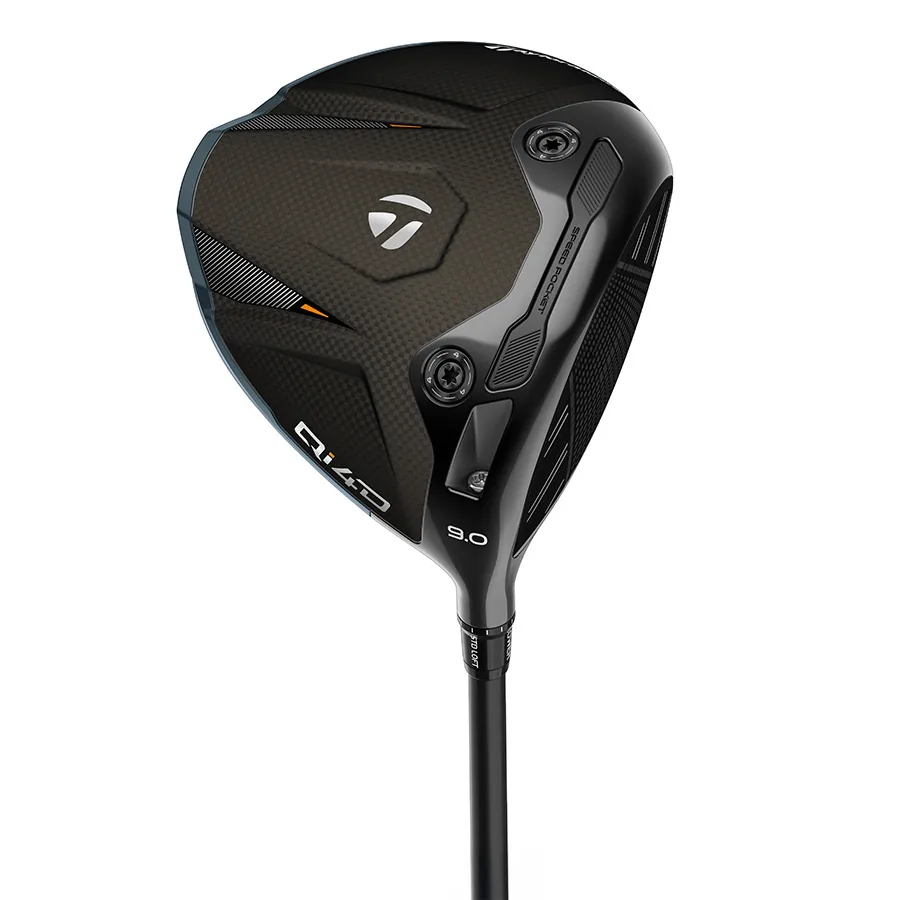
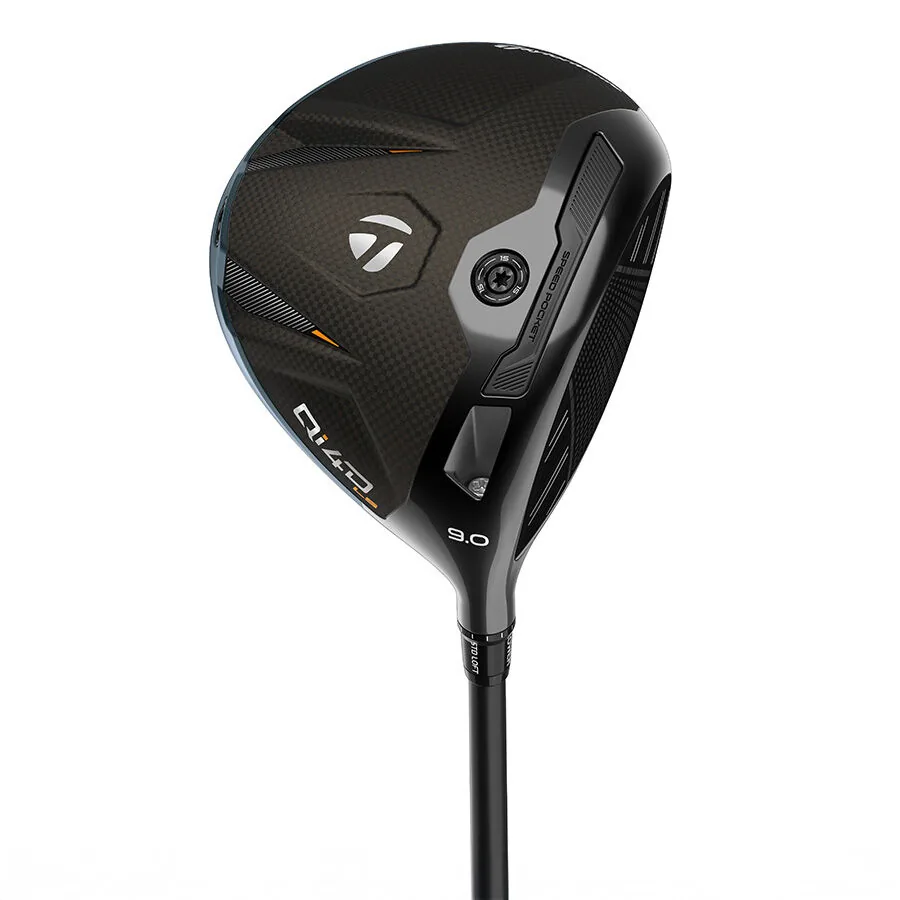
At address the difference is obvious. The Qi4D has a modern, confidence-inspiring shape built from Tour feedback: not a stretched max-MOI head, but a fuller footprint behind the ball. The LS is traditional and compact, aimed at "better players looking to capitalize on playability." It looks deeper-faced and more pear-like, which suits golfers who like to work the ball.
TaylorMade publishes no acoustic data. With the same carbon-face construction, both should feel broadly alike off the centre, while the smaller LS gives more feedback on mishits. Better players tend to like that; higher handicappers tend not to. Hit both before you buy, ideally outdoors with your own ball.
Performance: launch, spin and forgiveness
Launch
TaylorMade rates the Qi4D mid-high launch and the LS mid. The standard head's more rearward stock mass helps get the ball airborne, which matters for moderate swing speeds. Because the LS launches lower, loft choice is critical: many players moving to a low-spin head need to add loft, not remove it.
Spin
This is the headline difference. The LS has the most forward CG in the family and an ultra-low spin rating, against mid-low for the Qi4D. For a fast swinger whose drives balloon, that can mean a more penetrating flight and more total distance. For a player whose spin is already low, the LS can take out too much, producing a knuckling drive that falls out of the air. The standard Qi4D can also cut spin with its heavy weights forward, so it covers some of the same ground.
Forgiveness
The standard Qi4D is the more forgiving of the two, with a larger footprint and the option to push both 9g weights rearward. The LS is positioned around speed and spin. If you hit it all over the face, the Qi4D, or the even more forgiving Qi4D Max, is the safer bet. TaylorMade doesn't publish MOI figures for either head, so we don't quote any.
Ball speed
Both heads are rated "fastest." In practice, the faster driver for you is the one you hit in the centre more often, and for most amateurs that points to the standard Qi4D.
Adjustability compared
Both drivers share the 4° loft sleeve with 12 positions (±2°), which changes loft, lie and face angle together. The weights are where they part ways:
- Qi4D (four weights): heavy front for speed and low spin, heavy back for forgiveness and launch, heavy heel for draw, heavy toe for fade.
- Qi4D LS (two weights): mostly a front-to-back trade. 15g forward gives the lowest spin; 15g back adds stability, with little shot-shape bias.
A useful rule: the sleeve changes where the ball starts; the weights change how the head behaves through impact. If you fight a slice, the Qi4D's heel-weight setting is the tool for it, not the LS.
Shafts and fitting
For 2026, TaylorMade organised shaft fitting around how a golfer rotates the club through impact, with three Mitsubishi REAX profiles: High Rotation (HR), Mid Rotation (MR) and Low Rotation (LR). The Qi4D ships with lighter 50g MR and HR options plus an LR 60. The LS uses 60g versions across the board, listed at 63–67g, to match its faster-swinging target player. Custom options are available on both.
Standard length is 45.75", and TaylorMade notes custom builds can measure over the USGA 46" limit depending on grip, so check before competing. Our golf club length calculator is a good starting point.
Why the Qi4D vs Qi4D LS tests disagree
Read four reviews of these drivers and you get four different answers. Most of that comes down to who or what was swinging the club. The table below lists what each publication actually tested. Every figure links to its source, and nothing here is our own measurement.
What explains the split
- Speed changes the answer. The two single-tester reviews come from golfers swinging around 108–130 mph, which is where the LS is meant to shine. MyGolfSpy averages golfers of all speeds, and its swing-speed breakdown shows how much results move between groups.
- A robot doesn't play like a person. At 95 mph, Golf Digest's robot found the standard 10.5° Qi4D launching at 9.33° with 2,505 rpm. That's low for that speed, and it's why Golf Digest prefers the higher-launching 10.5° LS for a 95 mph swing. A robot also repeats its delivery exactly. A human tester's real-world misses are what pull the LS's MyGolfSpy accuracy score (8.5) below the Qi4D's (9.2).
- "Forgiveness" means different things. MyGolfSpy turns launch-monitor dispersion into a score. Golf Digest maps nine fixed impact points. Today's Golfer and IGR give a single golfer's impressions. These measure different things, so they can't be ranked against each other.
- Loft and weight settings aren't held constant. IGR played the LS with the heavy weight back, and Golf Digest tested 8°, 9° and 10.5° heads at three sleeve settings. Small setup changes move launch and spin by hundreds of rpm in the robot data.
Decision table: swing speed and attack angle
| Under 90 mph | Neither as a first choice. IGR rates the LS "not ideal" here. Look at the Qi4D family's higher-launch heads (IGR suggests Max Lite for slower swings). |
| ~90–105 mph, level or downward attack angle | Standard Qi4D, with more loft. It leads MyGolfSpy's mid-speed test (9.3). Golf Digest warns the lineup's low launch "can put the ball on the ground earlier" for neutral attack angles, so test it at +1° or +2° on the sleeve. |
| ~95 mph, needs launch | Try the 10.5° LS too. In Golf Digest's robot test it was the only Qi4D head inside the optimal launch window at every sleeve setting. |
| 105+ mph, upward attack angle, spin too high | Qi4D LS. This matches what both single-tester reviews found. If you also need forgiveness, MyGolfSpy notes the Qi4D's playable rate drops to 73.2% at high speeds. |
Attack-angle guidance paraphrases Golf Digest's analysis. The speed bands mix IGR's own bands with MyGolfSpy's groups and aren't one shared standard.
Who should buy the Qi4D or Qi4D LS?
| High handicap, inconsistent strike | Qi4D (or Qi4D Max). Forgiveness and draw-bias settings matter more than spin. |
| Mid handicap, average speed | Qi4D. Mid-high launch with a mid-low spin baseline suits most swings. |
| Fast swing, spin too high | Test both. Go LS if centred strikes still balloon on a launch monitor. |
| Low handicap, consistent strike | Qi4D LS. Compact shape, forward CG, lowest spin in the family. |
Tour bags back up that split: Nelly Korda moved into a standard Qi4D, while Collin Morikawa and Tommy Fleetwood carry the LS. Still gaming a fitted Qi10? Read our Qi10 driver review and the Qi4D review side by side first.
Pros and cons
TaylorMade Qi4D
Pros
- Four weights for speed, forgiveness, draw or fade
- Forgiving, confidence-inspiring 460cc shape
- Mid-high launch helps moderate speeds carry
- Widest loft range, including 12°
- Lighter 50g stock shaft options
Cons
- Not the lowest-spinning option for very fast swingers
- Larger look may not suit shot-shapers
- Premium $649.99 price
TaylorMade Qi4D LS
Pros
- Lowest spin and most forward CG in the family
- Aerodynamic compact head built for speed
- Traditional shape better players prefer
- Simple two-weight spin/stability trade
Cons
- Less forgiving on off-centre strikes
- Little draw bias; won't fix a slice
- No 12° loft, and lower launch
- Heavier stock shafts may not suit slower swings
Methodology: how we built this comparison
We don't have our own launch-monitor data for these drivers yet. Specs come from TaylorMade's published launch material and the Golf Digest Hot List. Performance figures are quoted from the four sources in the table above and linked where they appear. Where sources conflict, as on LS head volume, we show both. Figures were checked against the live source pages on October 21, 2026. Prices are US launch prices and may have changed since.
Qi4D vs Qi4D LS FAQ
Why do Qi4D vs Qi4D LS reviews disagree?
Testers swing at very different speeds. Single-tester reviews at roughly 108–130 mph favour the LS. MyGolfSpy's 35-golfer pooled test scores the standard Qi4D higher (9.2 vs 8.9). Golf Digest's 95 mph robot test preferred the 10.5° LS for launch.
Is the Qi4D LS longer than the Qi4D?
Not automatically. TaylorMade rates both heads "fastest" for ball speed. The LS spins less, which can add distance for fast swingers with too much spin, but players with average or already-low spin often carry the standard Qi4D farther.
Do the Qi4D and Qi4D LS cost the same?
Yes. Both launched at $649.99 in the US. The Launch Monitor Enabled (LME) versions of either driver were $699.99.
What lofts do the Qi4D and Qi4D LS come in?
The Qi4D comes in 8° (right-hand only), 9°, 10.5° and 12°. The Qi4D LS comes in 8° (right-hand only), 9° and 10.5°. Both use a 4° sleeve that adjusts loft by ±2°.
Is the Qi4D LS good for high handicappers?
Usually not. It has the most forward centre of gravity in the family and fewer weights for forgiveness or draw bias. Most high handicappers will do better with the Qi4D or Qi4D Max.
What is the difference in weights between the Qi4D and Qi4D LS?
The Qi4D has four TAS weights (two 9g and two 4g) for speed, forgiveness, draw and fade setups. The Qi4D LS has two weights (15g and 4g), mainly to trade low spin for extra stability.
Which shafts come stock in the Qi4D and Qi4D LS?
Both use Mitsubishi REAX shafts in High, Mid and Low Rotation profiles. The Qi4D offers 50g MR and HR options plus an LR 60, while the LS uses 60g versions.