
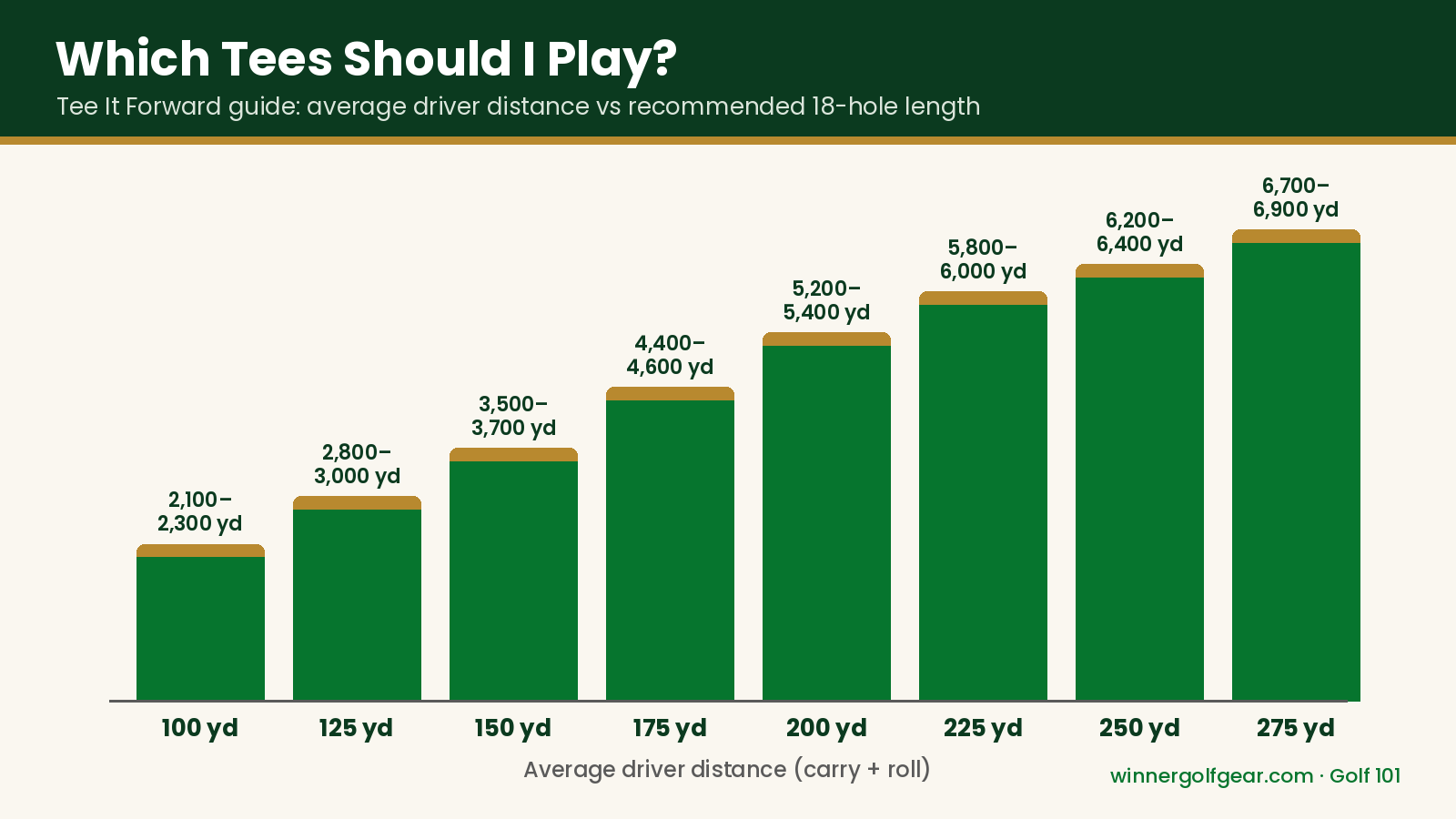
The Tee It Forward chart
Takeaway: Match the course length to your average drive, not your best one.
Tee It Forward is a joint PGA of America and USGA initiative that encourages golfers to play a course length matched to their driving distance. The ratio column is our own calculation from the chart's midpoints.
| Average driver distance (yards) | Recommended 18-hole yardage | Ratio: course length ÷ drive (WGG calc.) |
|---|---|---|
| 275 | 6,700–6,900 | about 24.7× |
| 250 | 6,200–6,400 | about 25.2× |
| 225 | 5,800–6,000 | about 26.2× |
| 200 | 5,200–5,400 | about 26.5× |
| 175 | 4,400–4,600 | about 25.7× |
| 150 | 3,500–3,700 | about 24.0× |
| 125 | 2,800–3,000 | about 23.2× |
| 100 | 2,100–2,300 | about 22.0× |
Quick shortcut: for drives between 150 and 275 yards, the recommended course length works out at roughly 24 to 26.5 times your average drive. Multiply your drive by 25 for a quick estimate, then pick the set of tees on the scorecard whose total yardage is closest.
How to measure your average drive
Takeaway: Use your typical drive, including the mishits, not the one you remember.
- On the course: on a few flat holes, note the distance left to the green after a normal drive (from a marker, sprinkler head or GPS app) and subtract it from the hole length. It is the simplest reliable method.
- Launch monitor: hit 10 drives, drop the best two and worst two, and average total distance.
- Repeat over several rounds. One day's numbers can be skewed by wind or firm ground.
If your drives are short for your effort, the club may be the issue: our driver loft guide and shaft flex guide cover the two most common misfits.
Signs you are on the wrong tees
| Sign | Probably… |
|---|---|
| Hybrid or fairway wood into most par 4s | Too far back |
| Can't reach most par 3s with any club | Too far back |
| Your group is waiting on you every hole | Too far back |
| Driver often leaves you a wedge into par 4s | You could move back if you want more challenge |
A worked example
Say your average drive is 190 yards. Multiplying by 25 gives about 4,750 yards. On a scorecard with tees at 6,450, 5,900, 5,300 and 4,700 yards, the 4,700-yard set is the closest match, and the Tee It Forward rows either side (175 yards → 4,400–4,600; 200 yards → 5,200–5,400) confirm you belong somewhere between them. If 4,700 feels too easy after a few rounds, try the 5,300 set; if your approach clubs into par 4s are mostly hybrids, stay forward.
Combo tees and family tees
Takeaway: Many courses now offer mixed or very short tee sets; they are rated and count like any other tees.
Some courses offer "combo" or "hybrid" tees that mix two sets (for example, the forward tee on long holes and the middle tee on short ones), creating a length between the standard sets. Others add very short "family" or junior tees, sometimes placed in the fairway, which suit new golfers and children. If a combo set has its own Course Rating and Slope Rating on the scorecard, you can post your score for handicap like any other set. They are a useful bridge when the gap between two standard sets is large.
Tee colours are not standard
Many courses use black or gold for the longest tees, then blue, white, and red or green for the shortest, but colours and names vary. Some courses name tees by number or yardage. Always go by the yardage on the scorecard, not the colour or any label suggesting who "should" play them.
What changing tees does to your score and handicap
Takeaway: Moving forward doesn't "cheat" your handicap; each tee has its own rating.
Every set of tees has its own Course Rating and Slope Rating, so the World Handicap System adjusts your Course Handicap for the tees you play. When players in the same competition use tees with different pars, the handicap rules include an adjustment for the par difference. You can post scores from any rated tees. Our handicap explainer covers the maths, and the handicap calculator lets you try it.
Our first-round tee plan
- Estimate your average drive (or use 175–200 yards if you have never measured it)
- Multiply by 25 for a target course length
- Pick the tees on the scorecard closest to that length, rounding down if unsure
- Tell your group which tees you are playing on the first tee
- After the round, check how many par 4s you reached in regulation or with a short iron; adjust next time
Common beginner mistakes
- Playing the tees your friends play regardless of distance.
- Using your best drive as the yardstick.
- Thinking forward tees are "for" one group of players. They are for anyone whose distance suits them.
- Switching tees mid-round in a competition; stay on one set.
- Ignoring pace. Shorter tees are one of the easiest ways to speed up play.
Frequently asked questions
How do I know which tees to play?
Match the course length to your average driver distance. Tee It Forward suggests about 5,800–6,000 yards for a 225-yard drive and 5,200–5,400 yards for a 200-yard drive.
What tees should a beginner play?
Usually a forward or middle set. Many beginners average 150–200 yards off the tee, which matches roughly 3,500–5,400 yards on the Tee It Forward chart.
Do tee colours mean the same thing at every course?
No. Colours vary by course, so use the yardage on the scorecard.
Does playing forward tees affect my handicap?
Each tee has its own rating, and the World Handicap System adjusts your Course Handicap accordingly, so your handicap stays fair.
What is Tee It Forward?
A joint PGA of America and USGA initiative that recommends course length based on your average driving distance.