
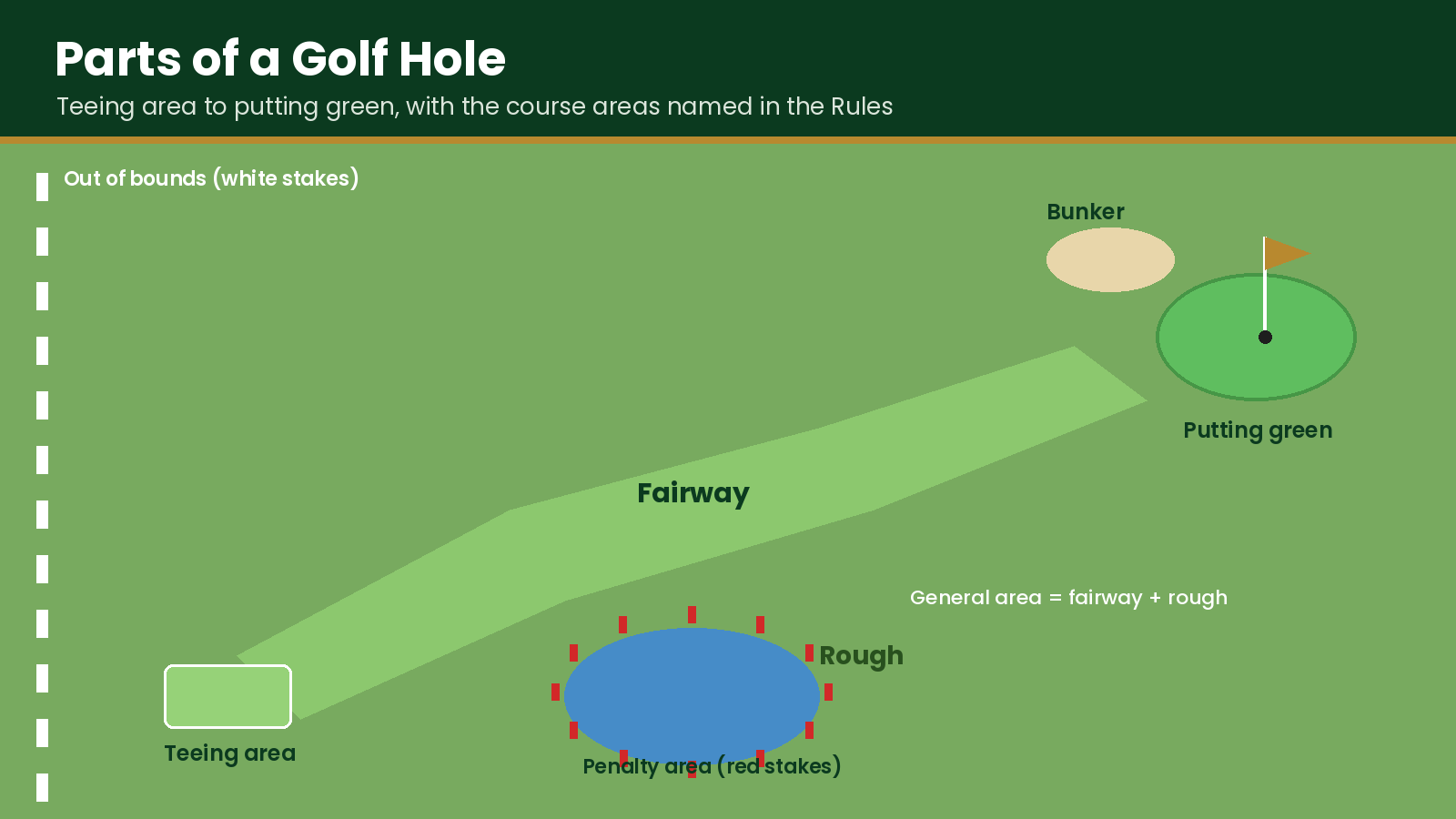
The five areas of the course
Takeaway: Every ball on the course is in exactly one of five areas, and each has its own rules.
| Area (Rules name) | What you see | Key rule for beginners |
|---|---|---|
| Teeing area | Flat area with two tee markers at the start of each hole | Tee up between the markers and up to two club-lengths behind them |
| General area | Fairway, rough, trees, paths: everything not in the other four | Play it as it lies; free relief only for abnormal conditions |
| Bunkers | Prepared sand areas | Don't touch the sand near the ball or in your backswing |
| Penalty areas | Water, ditches and other marked areas, red or yellow stakes | Play as it lies or take relief for one stroke |
| Putting green | Short, smooth grass around the hole | Mark, lift, clean, repair; flagstick may stay in |
Out of bounds is not one of the five areas: it is outside the course entirely.
A hole, from tee to cup
Takeaway: Most holes run tee, fairway, green, with rough, bunkers and penalty areas guarding the route.
- Teeing area: often several sets of tees in different colours at different distances (see which tees should I play).
- Fairway: the closely mown strip between tee and green. A ball here usually sits well.
- Rough: longer grass bordering the fairway. Many courses have a "first cut" of slightly longer grass, then deeper rough.
- Hazards: fairway and greenside bunkers, and penalty areas like ponds and streams.
- Fringe (collar or apron): the band of slightly longer grass around the green. It is part of the general area, not the green, so you can't mark and lift your ball there.
- Putting green and hole: the hole is 4.25 inches (108 mm) wide, and the flagstick shows where it is.
Markings and what they mean
| Marking | Meaning | Your options |
|---|---|---|
| White stakes / lines | Out of bounds | Stroke and distance (see OB vs penalty area) |
| Yellow stakes / lines | Yellow penalty area | Play it, or 1-stroke relief back on the line or replay |
| Red stakes / lines | Red penalty area | As yellow, plus lateral relief within two club-lengths |
| Blue stakes or white lines on the ground (varies by course) | Ground under repair | Free relief |
| Blue stakes with green tops (varies) | No-play zone | Must take relief |
| Coloured posts or plates in the fairway | Distance markers (often to the middle of the green) | Check the scorecard for what each colour means |
Course markings beyond white, yellow and red are set by each course's local rules, so read the back of the scorecard.
Beyond the 18 holes
- Driving range: for full-swing practice; see our alignment stick drills to make range time count.
- Practice green and chipping area: warm up putting speed before every round.
- Practice bunker: the only place to rehearse sand shots freely.
- Clubhouse and pro shop: check in, pay, get the scorecard and local rules.
Course types for beginners
| Type | What it is | Good for |
|---|---|---|
| Pitch and putt / par-3 course | Short holes, all par 3 | First rounds; short-game practice |
| Executive course | Mostly par 3s and short par 4s | Building to a full course |
| 9-hole course | Nine holes, sometimes played twice | Shorter time commitment; 9-hole scores count for handicap |
| Full-length 18-hole course | Mix of par 3, 4 and 5, usually par 70–72 | Once you can play at a steady pace |
Par for each hole is set mainly by length; see golf scoring terms.
Course rating and slope: the numbers on the scorecard
Takeaway: Course Rating and Slope Rating tell you how hard a set of tees plays, and they feed your handicap.
Each set of tees has a Course Rating (what a scratch golfer is expected to score) and a Slope Rating (how much harder it plays for a bogey golfer; 113 is the standard). They are how the World Handicap System converts your Handicap Index into strokes for that course. Our handicap explainer walks through the formula, and the handicap calculator does the maths.
Common beginner mistakes
- Marking the ball on the fringe. Only on the putting green.
- Grounding the club in a bunker. That's a penalty; in a penalty area it is allowed.
- Treating every stake as out of bounds. Check the colour.
- Taking free relief from rough or trees. They are part of the general area.
- Skipping the local rules on the scorecard.
Frequently asked questions
What are the parts of a golf course?
The Rules define five areas: the teeing area, the general area (fairway, rough and the rest), bunkers, penalty areas and the putting green. Out of bounds is outside the course.
What is the difference between the fairway and the rough?
The fairway is the closely mown strip between tee and green; the rough is the longer grass around it. Both are part of the general area under the Rules.
Is the fringe part of the green?
No. The fringe is part of the general area, so you can't mark and lift your ball there.
How big is a golf hole?
4.25 inches (108 mm) in diameter.
What do white stakes mean on a golf course?
Out of bounds. A ball fully beyond the boundary must be replayed under stroke and distance.