
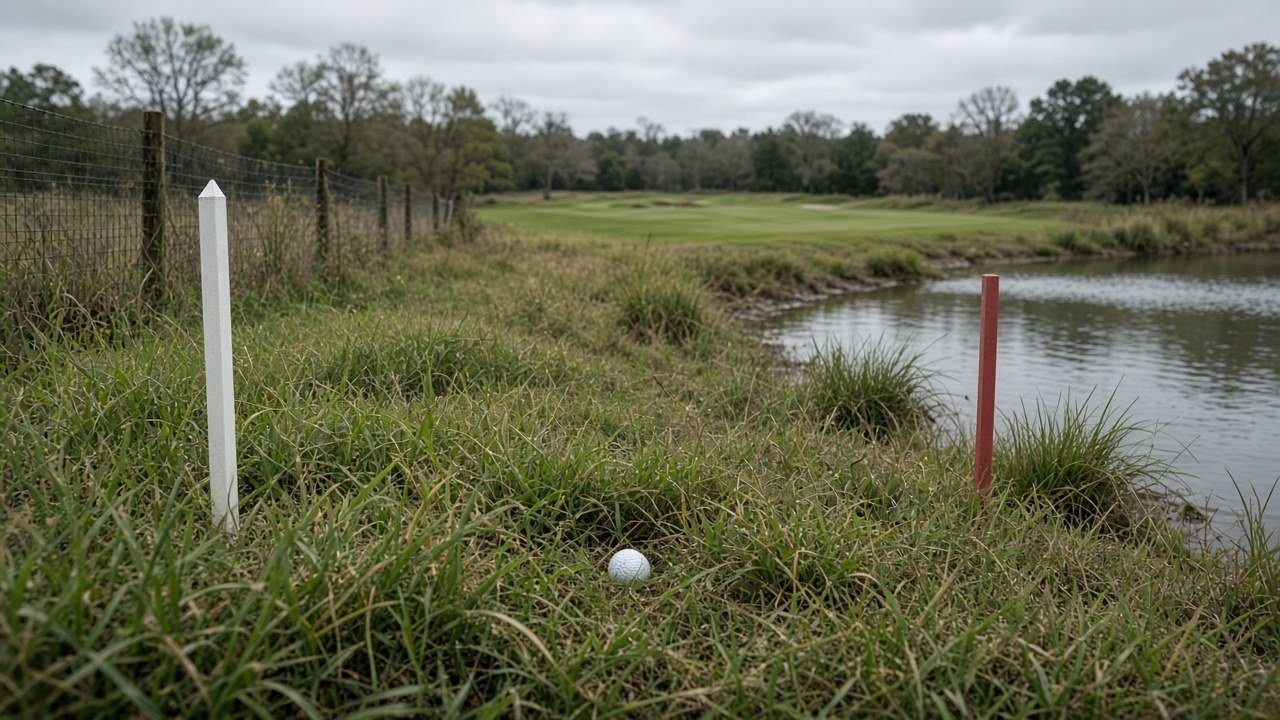
The colour code
Takeaway: White means gone; yellow means go back; red means go back or go sideways.
| Marking | What it is | Can you play the ball as it lies? | Relief options (1 penalty stroke each) |
|---|---|---|---|
| White stakes / lines | Out of bounds | No | Stroke and distance only (unless a local rule allows the two-stroke alternative) |
| Yellow stakes / lines | Yellow penalty area | Yes, no penalty | Stroke and distance; back-on-the-line |
| Red stakes / lines | Red penalty area | Yes, no penalty | Stroke and distance; back-on-the-line; lateral relief within two club-lengths |
Penalty areas are not only water: committees can mark deserts, jungle, ravines or any area where balls are often lost or unplayable.
When is a ball out of bounds?
Takeaway: The whole ball has to be beyond the boundary edge to be out.
The boundary edge is the course-side line between the inside points of white stakes, or the line itself if it is painted. A ball touching that line or any part of the course is still in bounds. You can stand out of bounds to hit a ball that is in bounds.
When is a ball in a penalty area?
A ball is in a penalty area when any part of it touches the area or lies inside its edge. So the rule is the opposite of out of bounds: only a sliver of the ball needs to touch the line.
Your options, step by step
Takeaway: For penalty-area relief you need "point X": where the ball last crossed the edge.
| Option | How to do it | Yellow | Red |
|---|---|---|---|
| Play it as it lies | Hit from inside the area. Since 2019 you may ground the club and move loose impediments. | Free | Free |
| Stroke and distance | Play again from where your previous stroke was made | +1 | +1 |
| Back-on-the-line | Keep point X between the hole and where you drop; go back as far as you like. Relief area is one club-length from the reference point you choose | +1 | +1 |
| Lateral relief | Drop within two club-lengths of point X, no nearer the hole | Not allowed | +1 |
All options from Rule 17.1d. A club-length means your longest club other than the putter. If you don't know how to drop, read how to take a drop first.
Lost, out of bounds or in the water? A decision chart
Takeaway: You need "known or virtually certain" evidence to treat a missing ball as in a penalty area.
- Did you find it within 3 minutes? Yes → play it, or take relief based on where it lies. No → go to 2.
- Is it known or virtually certain the ball is in a penalty area (you saw it splash, and there is nowhere else it could be)? Yes → use penalty-area relief from point X. No → go to 3.
- Otherwise the ball is lost. Take stroke and distance, or play your provisional.
The provisional ball: save the walk
If your ball might be lost outside a penalty area, or might be out of bounds, hit a provisional before going forward, and tell your group it is a provisional. If the original is found in bounds within three minutes, pick up the provisional. If not, the provisional becomes your ball in play with the stroke-and-distance penalty. A provisional is not allowed for a ball you only think is in a penalty area.
The local rule that changes everything (sometimes)
Many clubs adopt Model Local Rule E-5, an alternative to stroke and distance for casual play: for two penalty strokes you can drop near where the ball was lost or went out, including on the nearest fairway edge. It applies only if the committee has adopted it, and it is not meant for elite competitions. Check the local rules on the scorecard. The R&A publishes updates to these Model Local Rules each year.
Penalty math for a typical tee shot
| What happened off the tee | Your next shot from | You are hitting your… |
|---|---|---|
| Out of bounds | Tee again | 3rd shot |
| Into a red penalty area, lateral drop | Within 2 club-lengths of point X | 3rd shot |
| Into a yellow penalty area, back-on-the-line | Behind the area on the line from the hole | 3rd shot |
| Lost, local rule E-5 in use | Fairway-side relief area | 4th shot |
| In a penalty area but playable | Where it lies | 2nd shot |
Common beginner mistakes
- Dropping next to the white stakes. Without the E-5 local rule, out of bounds always means back to where you hit from.
- Taking lateral relief from a yellow area. Only red areas allow it.
- Measuring from where the ball came to rest instead of where it last crossed the edge.
- Hitting a provisional for a ball that clearly went into water. Not allowed; that ball is in the penalty area.
- Walking off without the right ball. Put a mark on your ball so you can identify it if it is found.
Fewer penalties usually beats more distance for new golfers. If your driver keeps finding the white stakes, our driver loft guide explains why more loft often means straighter tee shots, and the shaft flex guide covers the other common cause. If you are losing several balls a round, a cheaper two-piece ball from our beginner ball picks makes each penalty hurt less.
Frequently asked questions
What is the penalty for out of bounds in golf?
One penalty stroke, and you must replay from where you hit your previous shot (stroke and distance), unless a local rule allows the two-stroke alternative.
What is the difference between red and yellow stakes in golf?
Both mark penalty areas. Red areas allow lateral relief within two club-lengths of where the ball last crossed the edge; yellow areas do not.
Can you play a ball out of a penalty area?
Yes, without penalty. You may ground your club and move loose impediments in a penalty area.
Can you hit a provisional ball if you think your ball went in the water?
No. A provisional is only for a ball that might be lost outside a penalty area or might be out of bounds.
Is a ball on the out-of-bounds line in or out?
In. The whole ball must be beyond the boundary edge to be out of bounds.