
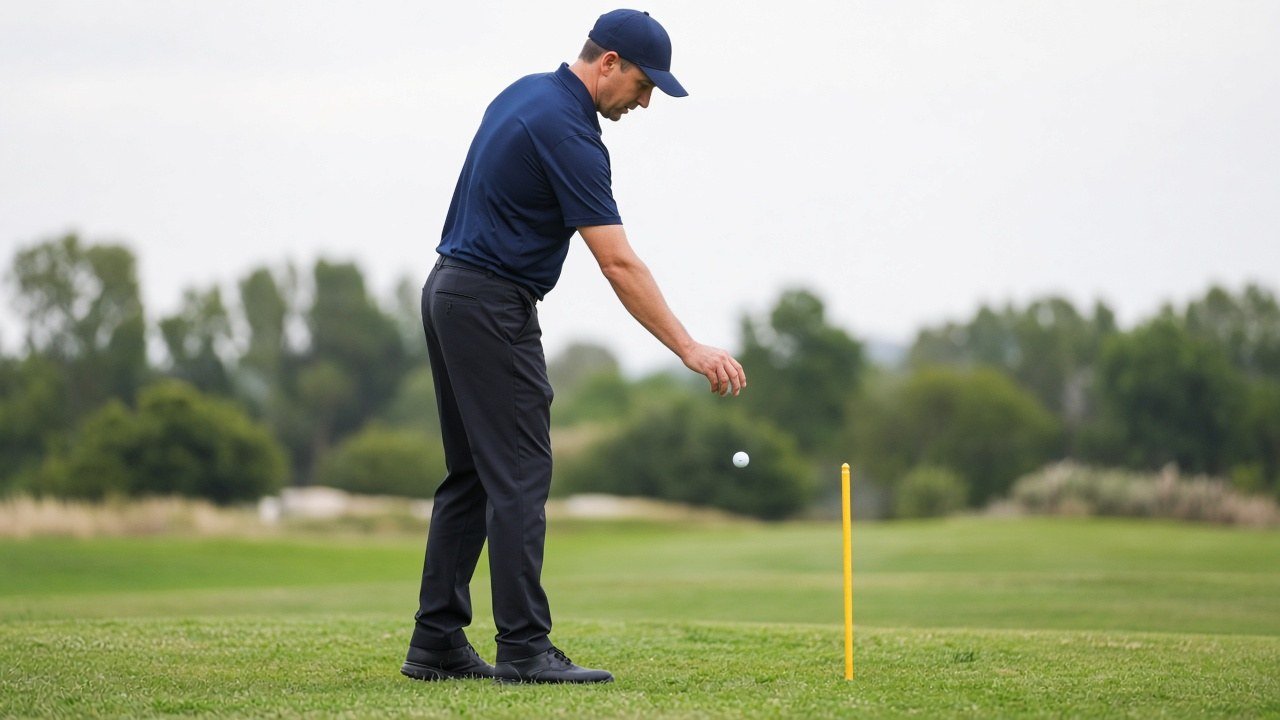
The drop in four steps
Takeaway: Reference point, relief area, knee height, rest inside: get those four right and every drop is legal.
- Find the reference point. Each relief rule gives you one: the nearest point of complete relief for a cart path, "point X" for a red penalty area, the spot of the ball for an unplayable lie.
- Measure the relief area. Use your longest club other than the putter (usually the driver) to measure one or two club-lengths from the reference point, no nearer the hole.
- Drop from knee height. Stand upright, hold the ball at knee height and let go. It must fall straight down without being thrown, spun or rolled, and must not touch you or your equipment before landing.
- Check where it stops. The ball must land in and come to rest in the relief area.
Relief area sizes at a glance
Takeaway: Free relief is usually one club-length; penalty relief sideways is usually two.
| Situation | Reference point | Relief area | Penalty | Rule |
|---|---|---|---|---|
| Cart path, sprinkler head, ground under repair, temporary water (general area) | Nearest point of complete relief | 1 club-length | None | 16.1b |
| Embedded ball in the general area | Spot right behind the ball | 1 club-length | None | 16.3b |
| Red penalty area, lateral relief | Where the ball last crossed the edge | 2 club-lengths | 1 stroke | 17.1d |
| Penalty area, back-on-the-line | A point you choose on the line back from the hole | 1 club-length from that point | 1 stroke | 17.1d |
| Unplayable ball, lateral relief | Spot of the ball | 2 club-lengths | 1 stroke | 19.2c |
| Stroke and distance (in the general area) | Where the previous stroke was made | 1 club-length | 1 stroke | 14.6 |
What if the ball rolls out?
Takeaway: Two drops, then place: you never have to drop a third time.
If the dropped ball comes to rest outside the relief area, drop again. If it rolls out a second time, place the ball on the spot where it first touched the ground on the second drop. If the ball won't stay there, place it at the nearest spot where it will stay, no nearer the hole.
A dropped ball that bounces off a person or equipment after hitting the ground is fine as long as it ends up in the relief area. If it hits a person or equipment before it reaches the ground, drop again.
The club-length question
A "club-length" is the length of the longest club in your bag other than your putter. For most golfers that is the driver, which is typically 45–46 inches; PING's current G440 Max driver, for example, is 46 inches standard. If you carry no driver, your fairway wood or hybrid sets the club-length, which makes your relief areas a little smaller. You can work out your own club lengths with our golf club length calculator, and see how driver lengths and lofts compare across brands in the golf drivers guide.
Free relief from a cart path, worked through
Say your ball stops on a cart path on the right side of the fairway. Find the nearest point where neither the ball, your stance nor your swing touches the path, no nearer the hole: that is the nearest point of complete relief. It may be on the far side of the path if that is nearer. Mark it with a tee, measure one club-length from it (no nearer the hole), and drop from knee height inside that area. Your stance must be clear of the path too, so right-handers often end up farther left than they expect.
Drops that changed in 2019
| Old way (before 2019) | Current way |
|---|---|
| Drop from shoulder height | Drop from knee height |
| Re-drop if the ball rolled more than two club-lengths or nearer the hole (nine re-drop situations) | Ball simply has to come to rest inside the relief area |
| Measure the area; ball could roll outside it | The relief area is the whole story |
If someone in your group drops from shoulder height, they are following the old rule. The knee-height rule is in the current 2023 Rules, which stay in force until 2028.
The drop pre-check
- Am I entitled to relief here, and is it free or a penalty?
- Have I identified the correct reference point?
- Have I measured with my longest non-putter club?
- Is my relief area no nearer the hole?
- For free relief: does the drop area give complete relief (stance and swing too)?
- Am I dropping straight down from knee height?
Common beginner mistakes
- Dropping from shoulder height. That is a wrong procedure; in stroke play, playing a ball dropped the wrong way costs one stroke if you don't correct it first.
- Measuring with the putter. The putter is excluded.
- Placing instead of dropping. You only place after two drops have rolled out (or where a rule says place, like on the green).
- Taking relief "nearest the hole". The relief area can never be nearer the hole than the reference point.
- Keeping part of the problem. For cart paths you must take complete relief from the path, including your stance.
Knowing your options also changes club choice. If a lateral drop leaves you in rough, a hybrid is often easier than a long iron (see hybrid vs iron), and a forgiving ball such as those in our beginner ball guide helps out of thicker lies.
Frequently asked questions
What height do you drop a golf ball from?
Knee height, letting it fall straight down without throwing or spinning it.
How big is a relief area in golf?
One or two club-lengths from the reference point, depending on the rule, measured with your longest club other than the putter.
What happens if a dropped ball rolls out of the relief area?
Drop again. If it rolls out a second time, place it where it first touched the ground on the second drop.
Can you place the ball instead of dropping it?
Only after two drops have failed to stay in the relief area, or where a rule specifically says to place, such as on the putting green.
Which club do you use to measure a club-length?
The longest club in your bag other than your putter, usually the driver.