
Why the grip matters so much
Takeaway: Your hands are the only contact with the club; the grip largely decides where the clubface points at impact.
A grip that turns the hands too far one way tends to close the face (hooks) or open it (slices). Fixing the grip is often the quickest way for a beginner to straighten shots, which is why golf instructors start here.
Step by step (right-handed golfer)
- Sole the club with the face square to the target and the grip angled across your palm.
- Lead hand: lay the grip from the base of your index finger diagonally to just below the base of your little finger. Close the hand so the heel pad sits on top of the grip.
- Check: looking down, you should see two to three knuckles of the left hand, and the "V" between thumb and index finger should point roughly at your right shoulder.
- Trail hand: place it below the lead hand, grip in the fingers, palm facing the target. The lifeline of the right palm covers the left thumb.
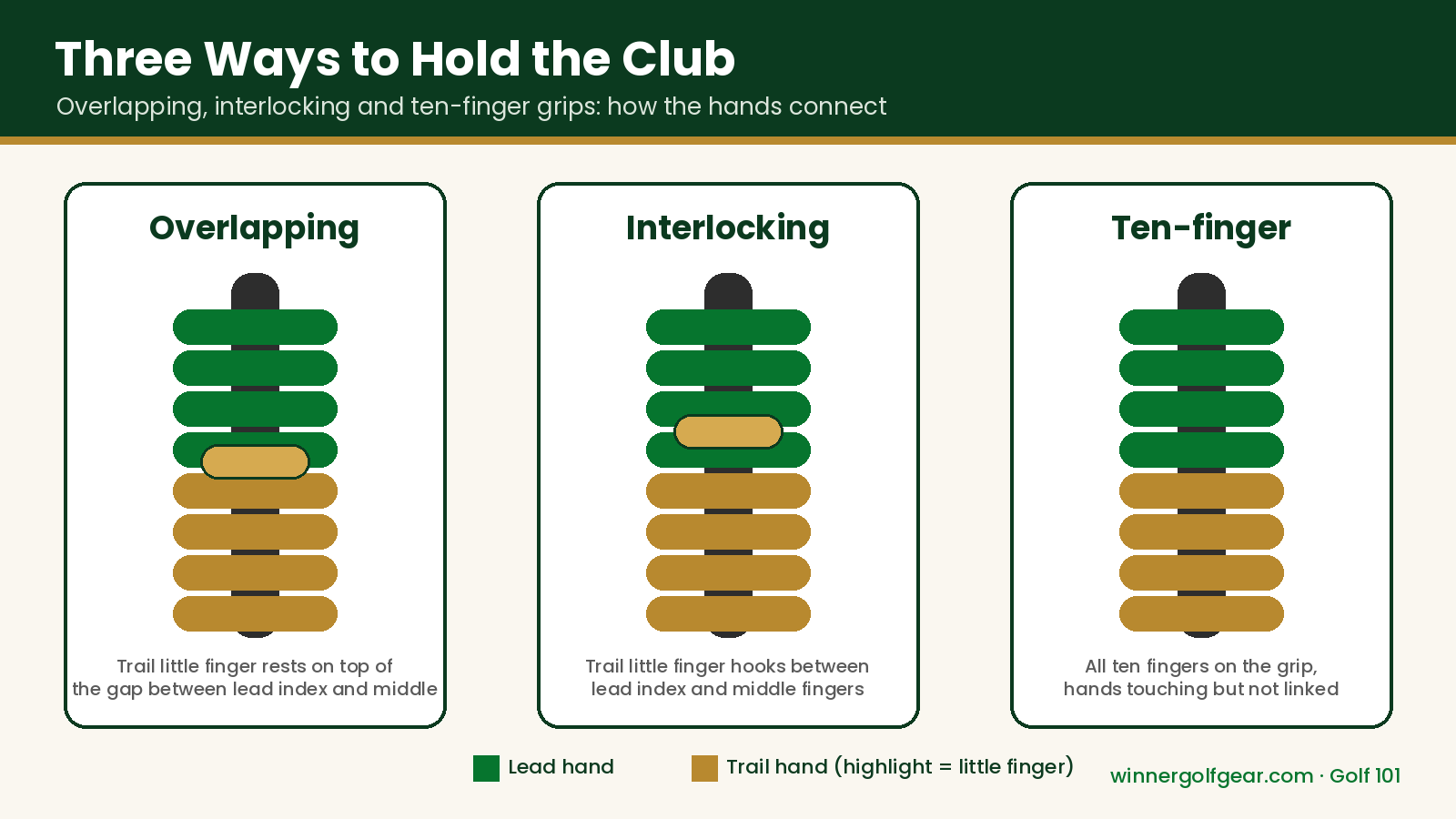
- Link the hands using one of the three styles below.
- Check the trail "V": it should also point between your chin and right shoulder.
Left-handed golfers mirror every step.
Overlap, interlock or ten-finger?
| Style | How | Suits | Watch out for |
|---|---|---|---|
| Overlapping (Vardon) | Trail little finger rests on top of the gap between lead index and middle fingers | Most adults with average or large hands | Can feel loose to beginners |
| Interlocking | Trail little finger hooks between lead index and middle fingers | Smaller hands, players who feel their hands separate | Pushing the fingers too deep into the palm |
| Ten-finger (baseball) | All ten fingers on the grip, hands touching | Juniors, players with weak hands or joint pain | Hands can work independently |
Takeaway: The best linking style is the one that keeps your hands working as a unit without tension; all three are used at the highest level.
Neutral, strong or weak
| Grip | What you see (right-hander) | Tendency | Good for |
|---|---|---|---|
| Neutral | 2–3 knuckles of lead hand; Vs to right shoulder/chin | Square face | Starting point for everyone |
| Strong | 3–4 knuckles; Vs point outside right shoulder | Closes face; draws or hooks | Players who slice |
| Weak | 1 knuckle or fewer; Vs point at chin or left | Opens face; fades or slices | Players who hook |
Grip pressure
Hold the club firmly enough to control it but loosely enough that your forearms stay soft. Many instructors use a 1–10 scale and suggest around 4–5 for full swings: the club shouldn't twist in your hands, and you should be able to waggle it freely. Squeezing hard tightens the arms and shoulders and slows the club. Keep the pressure even through the swing rather than tightening at the top.
The 60-second grip check (do this every range session)
- Lay an alignment stick at your target line and set the face square to it (see alignment stick drills)
- Count lead-hand knuckles: 2–3
- Both Vs point between chin and trail shoulder
- Lead thumb sits slightly right of centre on the grip, under the trail lifeline
- No gap between the hands
- Pressure about 4–5 out of 10
- Take a photo from face-on once a month to compare
Grip size and condition
Takeaway: Worn or wrong-sized grips make you squeeze harder.
Club grips come in undersize, standard, midsize and jumbo. Too thin and the hands can become overactive; too thick and it can be hard to release the club. Replace grips when they turn shiny or hard. Grip thickness and club length are the two fitting basics you can sort without a launch monitor; our golf club length calculator handles the length side. If you buy second-hand clubs, regripping is often the first job (see used golf clubs for beginners).
Grip for putting is different
Putting grips are designed to quieten the wrists, and the putter grip may be flat-sided, which other clubs can't be. Popular putting styles include reverse-overlap, cross-handed (lead hand low), claw and arm-lock. Anchoring the putter against the body isn't allowed. See putting tips for beginners.
Common beginner mistakes
- Holding the club in the palm of the lead hand instead of the fingers.
- Squeezing too hard, especially on the driver.
- A very weak grip (one knuckle or none) that leaves the face open: a common cause of slices.
- Gap between the hands.
- Changing grip every shot after a bad result. Pick a neutral grip and give it a few sessions.
Once your grip is set, wear your glove on the correct hand (which hand) and move on to stance and ball position. Keep a few pairs of fresh grips on your list in the golf accessories guide.
Frequently asked questions
What is the correct way to grip a golf club?
Hold the club in the fingers of your lead hand with two to three knuckles visible, place the trail hand so its palm faces the target and covers the lead thumb, link the hands, and keep pressure light.
Is interlocking or overlapping grip better?
Neither is better for everyone. Overlap suits most adults with average or large hands; interlock suits smaller hands or players who feel their hands separate.
How tight should you grip a golf club?
Firm enough to control the club, light enough that your forearms stay relaxed. Many instructors suggest about 4–5 on a 10-point scale.
Can a strong grip fix a slice?
Often it helps, because a stronger grip tends to close the clubface. Make the change gradually.
Should I use a baseball grip?
It can suit juniors, players with small or weak hands, or joint pain. Many adults switch to overlap or interlock as they improve.