
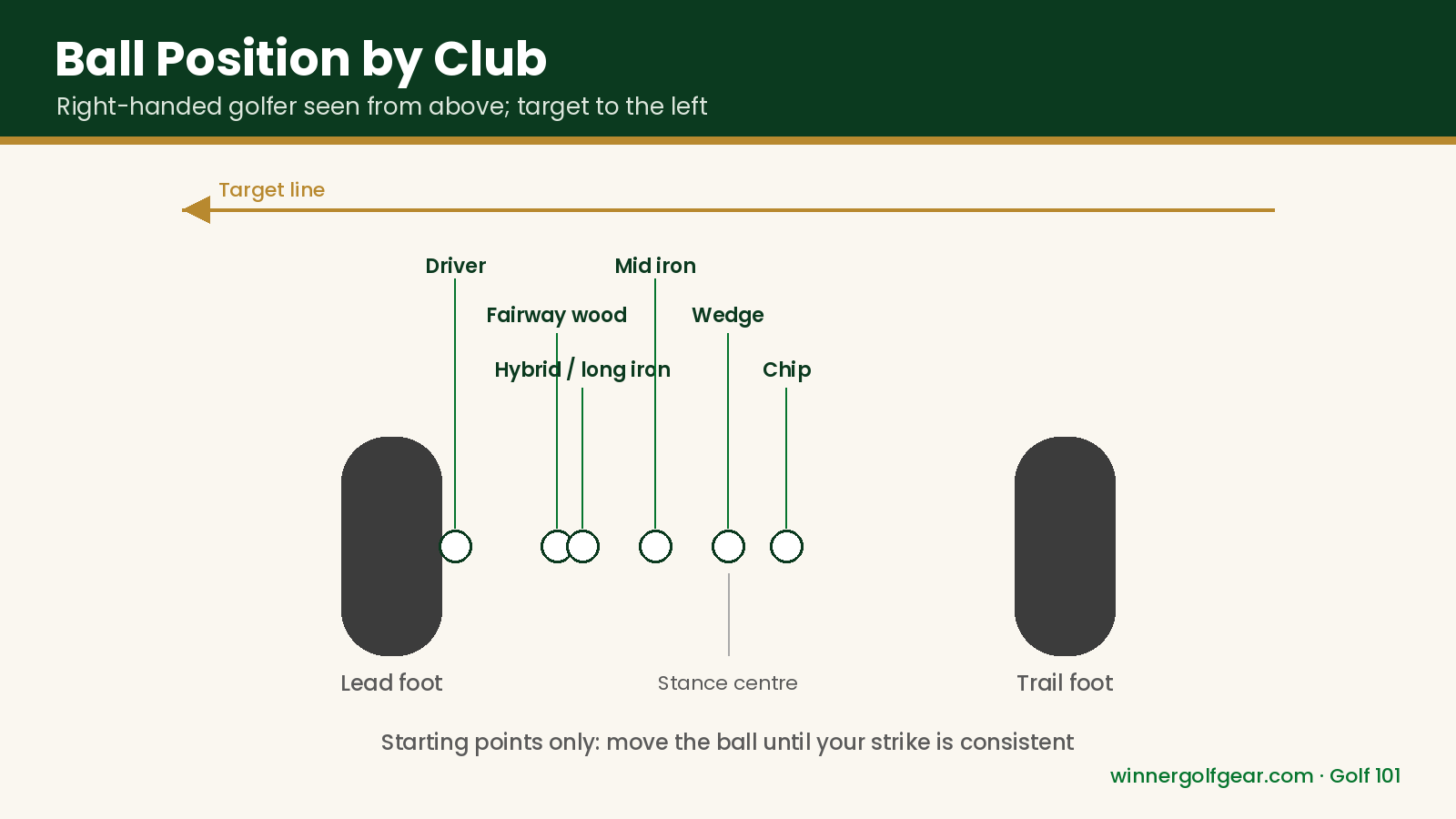
Ball position chart
Takeaway: The longer the club, the farther forward the ball and the wider the stance.
| Club | Ball position (right-hander) | Stance width | Why |
|---|---|---|---|
| Driver | Inside the left heel | Slightly wider than shoulders | Lets you strike on a slightly upward path off the tee |
| Fairway woods | 1–2 balls inside the left heel | Shoulder width | Sweeping strike at the bottom of the arc |
| Hybrids / long irons | About 2 balls forward of centre | Shoulder width | Slightly descending strike |
| Mid irons (6–8) | About 1 ball forward of centre | Just inside shoulders | Ball first, then turf |
| Short irons and wedges | Centre | Narrower | Steeper strike, more control |
| Chips | Centre to slightly back; weight left | Narrow, feet close | Ball-first contact (see chipping vs pitching) |
These are widely taught starting points, not fixed rules. Body shape and swing style can shift them by a ball or so.
Posture in five checkpoints
- Feet: about shoulder width for a mid-iron, weight on the balls of the feet.
- Hip hinge: push your hips back and tilt your upper body forward from the hips, keeping your back fairly straight.
- Knees: slight flex, not a deep squat.
- Arms: hang naturally from the shoulders; hands roughly under your chin to a fist's width from your thighs.
- Weight: about 50/50 for irons; a touch more on the trail side for the driver.
Takeaway: If you have to reach for the ball or stand bolt upright, the club length or lie may not fit you.
Club length affects posture. If you are tall or short and feel cramped or stretched, check your lengths with our golf club length calculator.
Alignment: parallel lines
Think of railway tracks: the ball and clubface on the outer rail pointing at the target, and your feet, knees, hips and shoulders on the inner rail, parallel to it. Most beginners aim their body at the target, which actually points the shot to the right of it for a right-hander. Lay one alignment stick along your toes and one pointing at the target to train the picture; our alignment stick guide includes body-alignment and ball-position drills you can do in a single range bay.
Why the driver is different
Takeaway: Forward ball position plus a tee lets you hit up on the driver; that changes the loft you need.
With the ball forward and teed up (see how high to tee a golf ball), you strike after the low point of your swing. That upward strike launches the ball higher with less spin. Golfers who hit down on the driver usually need more loft, which is explained with numbers in our driver loft guide.
Our set-up routine (8 seconds)
- Stand behind the ball and pick a target and an intermediate spot a metre in front of the ball
- Set the clubface square to that spot first
- Set your feet for the club (chart above)
- Hinge, let the arms hang, check grip (see how to grip a golf club)
- Look at the target once, back to the ball, swing
A short, repeatable routine helps with pace of play as well; the Rules recommend no more than 40 seconds per stroke.
Uneven lies: quick adjustments
| Lie | Ball position | Expect |
|---|---|---|
| Ball above feet | Normal; grip down | Ball tends to go left (right-hander) |
| Ball below feet | Normal; bend more at the knees | Ball tends to go right |
| Uphill | Slightly forward; shoulders match the slope | Higher, shorter: take more club |
| Downhill | Slightly back; shoulders match the slope | Lower, longer: take less club |
Range drill: the ball-position ladder
Takeaway: Practise set-up with three clubs in a row so the changes in ball position become automatic.
Lay one alignment stick along your toe line and a second at a right angle to it, pointing at the ball, as a ball-position reference. Hit five balls with a wedge with the ball level with the centre of your stance. Then take a 7-iron and move the ball one ball-width forward; hit five. Then a hybrid or fairway wood, another ball-width forward; hit five. Finish with the driver off a tee, inside the lead heel. Notice two things: the stance gets wider with each club, and the divot moves from just after the ball (wedge) to a light brush of grass (fairway wood) to no turf at all (driver). If your divots start behind the ball, the ball may be too far forward for that club, or your weight is staying on your trail side. Repeat the ladder at the start of each range session until you set up without thinking about it.
Common beginner mistakes
- Same ball position for every club, usually too far back with the driver or too far forward with wedges.
- Aiming the feet at the target, which closes the body to the right of it.
- Standing too far from the ball and reaching.
- Knees bent like a squat with no hip hinge.
- Too wide a stance with short irons, which restricts the turn.
Frequently asked questions
Where should the ball be in my stance for a driver?
Off the inside of your lead heel, with a stance a little wider than your shoulders.
Where should the ball be for irons?
Mid-irons about one ball forward of centre; short irons and wedges in the centre.
How wide should my golf stance be?
About shoulder width for mid-irons, slightly wider for the driver and narrower for wedges and chips.
Why do I aim right of the target?
Most beginners aim their feet at the target instead of parallel left of it. Use alignment sticks to train parallel lines.
Does ball position affect slices?
It can. A ball too far forward can encourage an open face at impact; too far back can cause pushes. Check grip and alignment as well.