
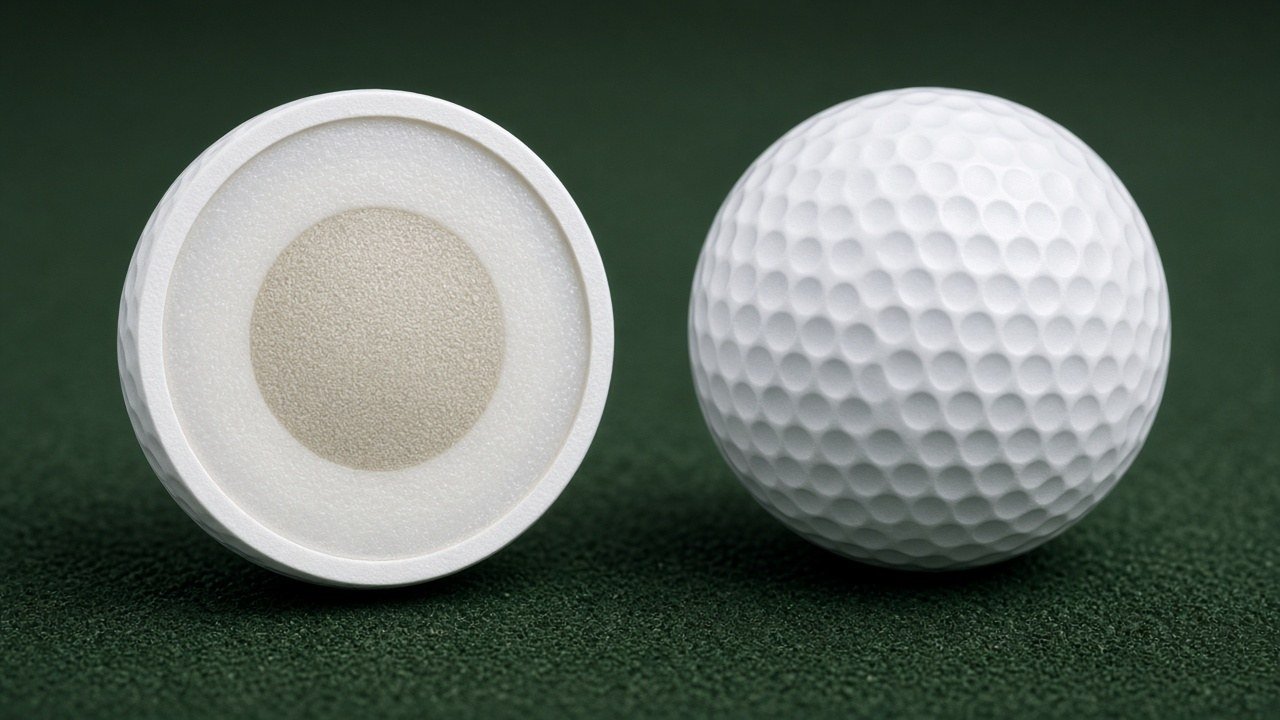
What compression actually is
Takeaway: Compression describes firmness under load, mostly set by the core.
When a club strikes a golf ball, the ball squashes against the face before springing off. A ball that deforms more under a given load is "lower compression" and feels softer; one that deforms less is "higher compression" and feels firmer. The number is a measured deflection on a gauge, so it depends on the gauge used, which is why figures from different testers don't always match.
What the rules control (and don't)
The Equipment Rules don't limit compression. They set a maximum weight of 1.620 ounces (45.93 g) and a minimum diameter of 1.680 inches (42.67 mm), plus performance tests for speed and distance. Within those limits, makers choose the core, layers and cover to tune feel, spin and distance.
Why you rarely see an official number
Takeaway: Treat any compression figure as a tester's reading unless the maker publishes it.
Several of the biggest brands talk about "soft" or "firm" feel rather than publishing a compression value. On our best golf balls for beginners page, for example, the figures for the Titleist TruFeel (about 70) and Callaway Supersoft (about 49) are independent gauge readings, because neither maker publishes one. When you compare balls, compare readings from the same source.
Compression, swing speed and feel
You will often read that slow swingers "need" low compression to get full distance. The mechanism is plausible, but the effect at amateur speeds is usually small next to strike quality. What low compression reliably changes is feel: softer off the putter and the irons, and often a little less spin off the driver. Treat compression as a feel and preference choice, then check distance on the course.
Construction: two-piece, three-piece and multi-layer
Takeaway: The number of layers and the cover material shape feel and spin more than a compression number does.
| Construction | Typical cover | What it does well | Trade-off |
|---|---|---|---|
| Two-piece (core + cover) | Ionomer (often branded, e.g. Surlyn-type) | Low driver spin, durability, low price | Less spin and "bite" on short shots |
| Three-piece | Ionomer or urethane | A middle ground of feel and spin | Costs more than two-piece |
| Multi-layer tour ball (3–5 pieces) | Urethane | High greenside spin, soft feel at high speed | Most expensive; cover scuffs on mishits |
A soft two-piece ball and a firm two-piece ball can feel very different even with the same construction; that is where compression shows up. But moving from a two-piece ionomer ball to a urethane tour ball changes short-game spin far more than moving between two compression readings. Each ball review on this site lists construction and cover as published by the maker, for example our Titleist TruFeel review.
What matters more for beginners
| Factor | Why it matters to a new golfer | What to pick |
|---|---|---|
| Price per ball | You will lose several balls per round at first | Low-cost two-piece balls |
| Cover | Ionomer covers are durable; urethane spins more but scuffs faster | Ionomer to start |
| Feel | Soft feel can help confidence on short putts and chips | Try a sleeve of two or three models |
| Visibility | Easier to find, fewer lost-ball penalties | Bright colours or alignment lines if you like them |
| Consistency | Same ball every round = predictable distances | Pick one and stick with it for a season |
The tour ball question
Takeaway: Most tour pros play a urethane, multi-layer ball like the Pro V1 or Pro V1x.
In our what golf ball do pros use analysis, Titleist balls appear in 110 of 167 tour bags tracked by DORMIED, and the Pro V1x is the single most common model in our own 37-player index. Those balls are built for high swing speeds and maximum greenside spin. They cost more per ball and scuff easily, which matters more to a beginner than any compression difference. Read our Pro V1 review before deciding whether a premium ball is worth it for you.
Our ball-choice framework
- Losing 3+ balls a round? Buy a low-cost two-piece ionomer ball by the dozen.
- Losing 1–2 a round and chipping more? Try a soft two-piece such as the Callaway Supersoft or a three-piece mid-price ball.
- Rarely losing balls and wanting more greenside spin? Test a urethane ball for a few rounds.
- Whatever you choose: use the same model for a month so your distances mean something.
Our golf balls guide lists every ball review on the site by brand and construction.
A simple at-home feel test
- Buy one sleeve each of two or three candidate balls
- Putt ten 3-metre putts with each on the practice green
- Chip ten balls of each to the same target
- Note which one you can judge distance with best, not which one "sounds" best
- Play nine holes with the winner before buying a dozen
Common beginner mistakes
- Buying tour balls to lose in the water. The spin benefit is mostly around the green.
- Comparing compression numbers from different testers.
- Switching balls every round. You can't learn distances that way.
- Choosing by driver distance claims alone. Most strokes are lost inside 100 yards.
- Ignoring the cover. Durability matters if you top or thin shots.
Frequently asked questions
What does golf ball compression mean?
How much the ball deforms under load. Lower compression feels softer; higher compression feels firmer.
Do beginners need low-compression golf balls?
Not necessarily. Low compression mainly changes feel. Price, durability and consistency matter more while you are learning.
What compression is a Pro V1?
Titleist does not publish an official compression number for the Pro V1; any figure you see is an independent measurement.
Does compression affect distance?
It can a little, depending on swing speed and the rest of the ball's design, but strike quality has a much bigger effect for most amateurs.
Are there rules on golf ball compression?
No. The Equipment Rules limit size, weight and performance, not compression.