
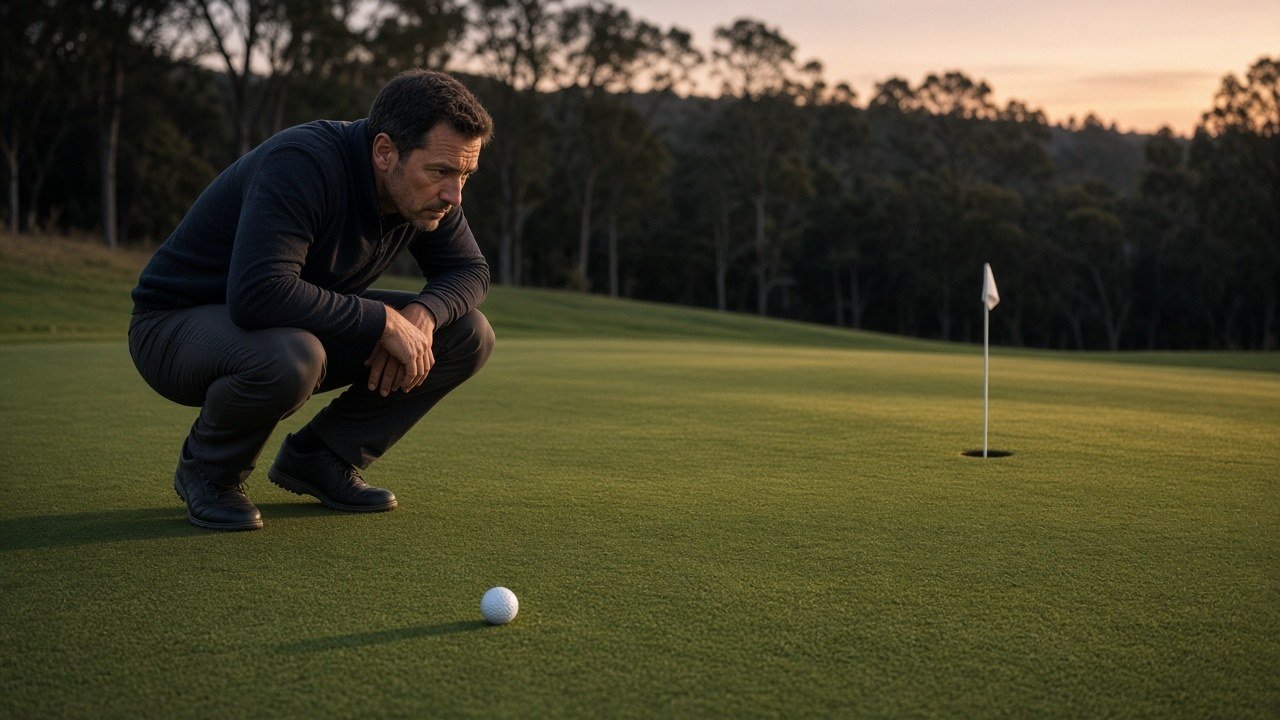
Speed first, line second
Takeaway: A putt with good speed but a slightly off line leaves a tap-in; a putt on line but 2 metres long leaves a nervy one.
Three-putts usually start with the first putt finishing far from the hole. That is why we put distance control at the top of the list for beginners. Aim to get long putts within a "tap-in circle" about the size of a dustbin lid around the hole, and to roll short putts slightly past the hole so they don't die off line.
Set-up checklist
- Feet about shoulder width or a little narrower; weight even
- Eyes over the ball or just inside it
- Ball slightly forward of centre
- Arms hanging, elbows relaxed; putter shaft in line with the lead forearm
- Putter face square to your start line (check it with a line on the ball or an alignment stick)
- Light grip pressure
If the putter's sole doesn't sit flat at address, or you feel cramped or stretched, the length may be wrong; see how to choose a putter.
The stroke
- Rock the shoulders; keep the wrists quiet.
- Make the backswing and through-swing about equal in length.
- Control distance with stroke length, not by hitting harder.
- Keep your head still until the ball is well on its way.
- Hold your finish for a second to check the face.
Reading greens: a simple method
Takeaway: Find the high side and the low side, then decide how hard to hit before choosing the line.
- Look from below the hole as you walk up: the low side shows slope best.
- Find the fall line, the line a ball would roll straight down to the hole.
- Uphill putts break less and need more pace; downhill putts break more.
- Choose the speed, then pick a start line that matches it.
- Commit: a confident stroke on a slightly wrong line often beats a hesitant one on the right line.
What the rules allow on the green
| You may… | Rule |
|---|---|
| Mark, lift and clean your ball on the green | 13.1b |
| Repair ball marks, shoe damage and other damage on the green | 13.1c |
| Leave the flagstick in the hole and putt (no penalty if it is hit) | 13.2a |
| Remove sand and loose soil on the green, and loose impediments such as leaves anywhere | 13.1c, 15.1 |
| Use any putter length, but not anchor it against your body | 10.1b |
| Not test the surface by rolling a ball or scraping it during the round | 13.1e |
Our 20-minute putting routine
| Minutes | Drill | Goal |
|---|---|---|
| 0–5 | Gate drill at 1 metre: two tees just wider than the putter head | Square face, centred strike |
| 5–12 | Ladder drill: putt to 5, 10 and 15 paces, three balls each | Distance control |
| 12–17 | Circle drill: six balls in a circle 1 metre around the hole | Hole every short putt |
| 17–20 | Play nine "holes" on the putting green, two putts each | Pressure and routine |
An alignment stick on the ground under your feet and pointing at the hole helps you check aim; our alignment stick drills include a putting set-up.
Putting styles you will see
Conventional (lead hand on top), cross-handed (lead hand low), claw, arm-lock and broomstick are all legal if the putter isn't anchored. Tour players use all of them. Adam Scott's broomstick putter is covered on our Adam Scott WITB page, and Scottie Scheffler's mallet on the Scheffler WITB page. Every putter in our Tour Bag Index is listed by model and bag date.
Green speed: adjust before you putt
Takeaway: Every course's greens roll at a different speed; your first five minutes on the practice green are for learning it.
Greens can roll very differently from course to course and from morning to afternoon, depending on mowing height, moisture and grass type. Before a round, hit three long putts across the practice green to a fringe and three back the other way; note how far the ball rolls for the same stroke length. Grain (the direction grass grows) can also make putts faster down-grain and slower into it on some grass types. On the course, watch other players' putts that roll near your line; they show you speed and break for free. And remember that uphill putts can be hit more firmly with less fear of a long one coming back, while downhill putts need the softest touch you have.
Track it
Write your putts per hole on your scorecard (see how to keep score). If three-putts are common, your practice should be mostly the ladder drill; if you miss a lot inside 1.5 metres, work on the gate and circle drills.
Common beginner mistakes
- Practising only short putts. Long-putt speed saves more strokes.
- Decelerating through the ball.
- Wristy strokes. Rock the shoulders.
- Reading the line before deciding the speed.
- Taking the flagstick out every time. Leaving it in is allowed and often faster.
Frequently asked questions
How can I stop three-putting?
Work on distance control so first putts finish close to the hole. Ladder drills to 5, 10 and 15 paces are the quickest fix.
Should you leave the flagstick in when putting?
You may. Since 2019 there is no penalty if your putt hits the flagstick in the hole.
Where should my eyes be when putting?
Over the ball or slightly inside it.
Can you repair spike marks on the green?
Yes. The Rules allow you to repair most damage on the putting green, including shoe damage and ball marks.
Is it legal to use a long putter?
Yes, as long as you don't anchor it against your body.