
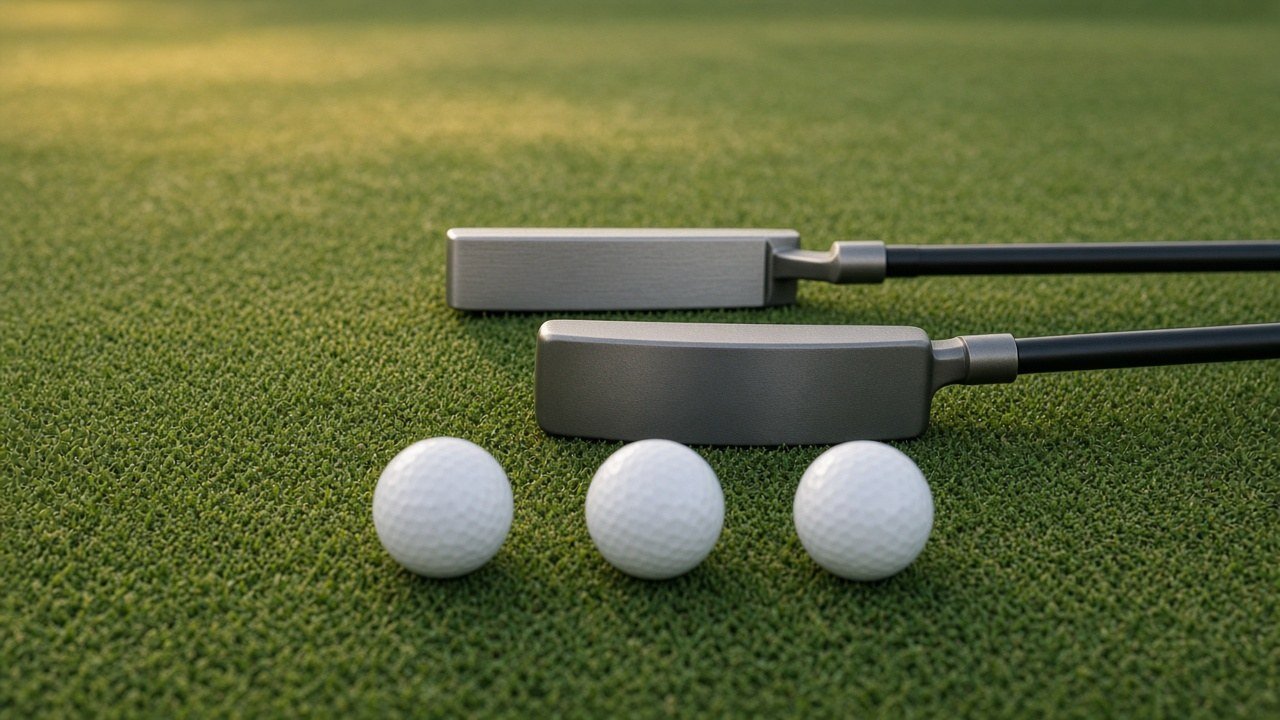
Why the putter deserves more attention than the driver
Takeaway: You use the putter on almost every hole, often twice; a driver maybe 14 times a round.
Beginners tend to spend the most on the driver and grab any putter. Reverse that thinking. A putter that fits your stroke and sets up square makes every green easier, and it is one of the few clubs where the most forgiving designs are also among the most widely played on tour. Scottie Scheffler, for example, uses a TaylorMade Spider Tour X mallet, according to our Scheffler WITB page.
Step 1: get the length right
Takeaway: The wrong length changes your posture, your eye line and where the face points.
Stand in your putting posture with your arms hanging naturally. A good length lets your hands sit under your shoulders and your eyes sit over the ball or just inside it, without crouching or reaching. Many off-the-rack putters come in lengths around 33 to 35 inches; taller players often need longer and shorter players shorter. Our golf club length calculator is built for full-swing clubs, but the wrist-to-floor measurement it uses is a good sanity check for putter fitting conversations too.
| Sign at address | Likely problem |
|---|---|
| Toe of the putter in the air | Putter too long or lie too upright for you |
| Heel in the air | Putter too short or lie too flat |
| Arms bent and elbows jammed into your sides | Too long |
| Bent over with your back rounded | Too short |
Step 2: blade or mallet
| Blade | Mallet | |
|---|---|---|
| Shape | Thin, traditional head | Larger head, often with alignment lines or fins |
| Forgiveness on off-centre hits | Less | More: weight spread away from the face keeps it from twisting |
| Alignment help | Simple top line | Usually more aids |
| Feel | Very direct feedback | Softer, more stable |
| Best for | Players with a consistent strike and an arcing stroke | Most beginners |
Step 3: toe hang or face-balanced
Takeaway: Match the putter's balance to the shape of your stroke.
Balance the shaft on your finger. If the face points at the sky, the putter is face-balanced, which suits a straighter back-and-through stroke. If the toe hangs down, it has toe hang, which suits a stroke that opens and closes in an arc. To see your stroke shape, lay an alignment stick on the ground and watch where the putter head travels relative to it; our alignment stick drills include a putting set-up.
Step 4: grip
Putter grips come in thin, mid and oversized. Thicker grips quieten the hands and suit players whose wrists get "flippy"; thinner grips give more feel. Putters are allowed grips that aren't round in cross-section, unlike other clubs, which is why flat-front putter grips are common.
Long putters and the anchoring rule
Takeaway: Long putters are legal; anchoring them against your body is not.
Rule 10.1b bans anchoring the club, either directly or by using a forearm as an "anchor point". You can still use a broomstick putter if the club and hands are held away from your body. Adam Scott is the best-known example on tour, as covered on our Adam Scott WITB page. Arm-lock putters, where the grip rests against the lead forearm, remain legal because the forearm counts as part of the hands holding the club.
The 20-minute in-store test
- Take your normal posture before you look at the putter head
- Check the sole sits flat (neither toe nor heel up)
- Aim at a target 2 metres away, then have someone check where the face actually points
- Hit ten 3-metre putts and count how many start on your line
- Hit five long putts and see how close they finish
- Repeat with a blade and a mallet; pick the one that aims truer, not the one that looks better
Our putter chooser
| If you… | Try first |
|---|---|
| Are a new golfer with no idea about your stroke | Face-balanced mallet, mid-size grip |
| Miss short putts both ways | Mallet with strong alignment lines |
| Have trouble with distance on long putts | Blade or small mallet with a softer face feel; practise lag drills |
| Feel your hands take over | Oversized grip or arm-lock style |
| Have back pain bending over | Longer putter, or broomstick (unanchored) |
Common beginner mistakes
- Choosing by looks or a pro's brand. Pick the putter that aims straightest for you.
- Using a putter that is too long and choking down on it, which changes the lie and balance.
- Ignoring aim. Many golfers aim the face off line without knowing; test with a friend or an alignment stick.
- Anchoring a long putter against the belly or chest. That is a two-stroke penalty in stroke play.
- Never practising putting while spending hours at the range. See our putting tips.
Want to see which putters tour players carry? Every player row in the Tour Bag Index lists the putter model and the date of the bag report.
Frequently asked questions
Should a beginner use a blade or mallet putter?
Most beginners do better with a mallet because it is more forgiving on off-centre hits and usually easier to aim.
How do I know what length putter I need?
Take your putting posture with arms hanging naturally. The right length lets your eyes sit over or just inside the ball without crouching or reaching.
Is a long putter legal?
Yes, as long as you don't anchor it against your body. Anchoring has been banned since 2016 under Rule 10.1b.
What is the difference between face-balanced and toe hang?
A face-balanced putter's face points up when balanced on a finger and suits straighter strokes. Toe hang suits strokes that arc.
Is there a length limit for putters?
No. The 48-inch maximum applies to all clubs except putters.