
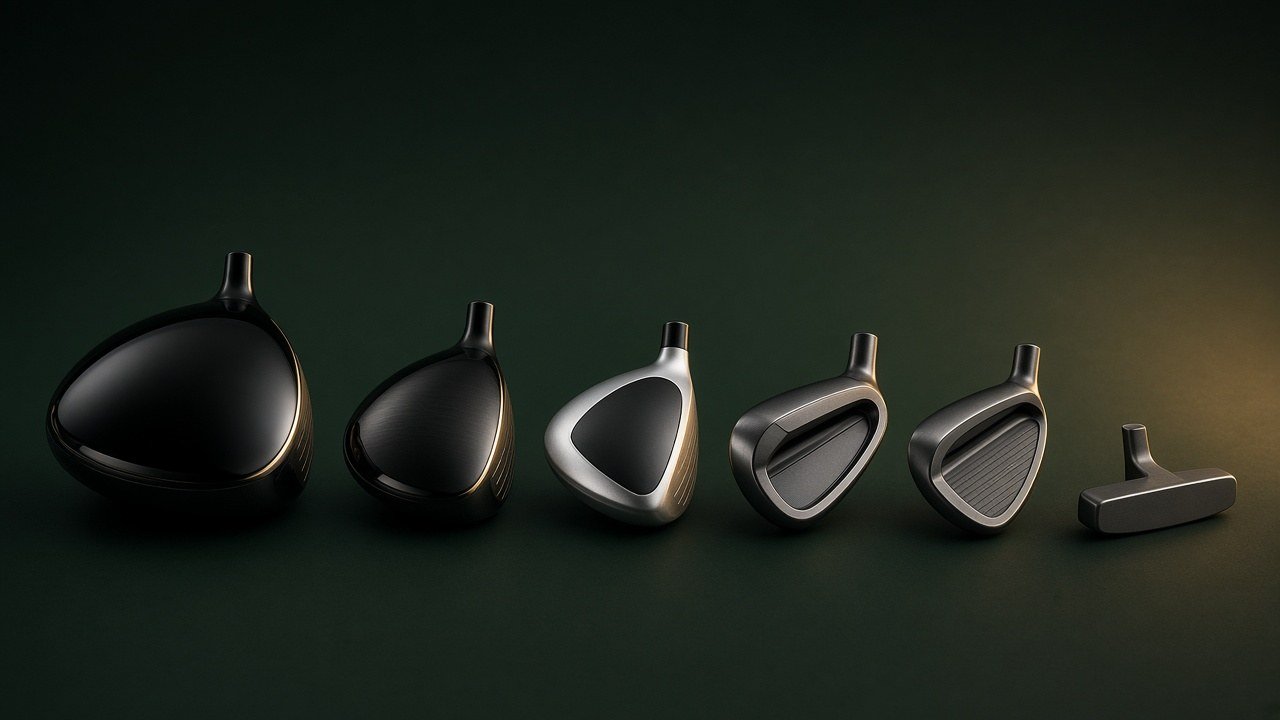
The five families at a glance
Takeaway: Loft goes up and length goes down as you move from woods to wedges.
To keep the comparison fair, every number below comes from one current family of game-improvement clubs, PING's G440 range and s159 wedges. Other brands differ by a degree or half an inch, not more.
| Type | Example | Loft | Standard length | Main use |
|---|---|---|---|---|
| Driver | G440 Max | 9°, 10.5°, 12° | 46" | Tee shots |
| Fairway woods | G440 Max 3-, 5-, 7-, 9-wood | 15°–24° | 43"–41.5" | Long shots off the ground or tee |
| Hybrids | G440 2H–7H | 17°–34° | 40.75"–38.25" | Replacing long irons |
| Irons | G440 4-iron to PW | 19°–42° | 39.25"–35.5" | Approach shots |
| Wedges | s159 | 46°–58° and up | 35.5"–35" | Short shots, bunkers |
| Putter | Any | Usually a few degrees | Often 32"–36" (no maximum) | Rolling the ball on the green |
Woods: driver and fairway woods
Takeaway: Woods have big, hollow heads and the longest shafts for maximum distance.
They are called woods because heads were once made of persimmon; today they are titanium, steel and carbon. The driver has the largest head the Rules allow, 460cc plus a small tolerance, and is normally hit off a tee. Fairway woods are smaller and shallower so they can be hit off the grass. Beginners usually find a 5- or 7-wood easier than a 3-wood. Our golf drivers guide covers drivers by brand and year, and the driver loft guide explains which loft to choose.
Hybrids
A hybrid has a head shaped like a small wood and a length close to an iron. The low, deep weight makes it easier to launch than the long iron it replaces. PING lists equivalents for each: its 4-hybrid (23°) replaces a 4-iron, and its 3-hybrid (20°) replaces a 3-iron or a 7-wood. More in hybrid vs iron.
Irons
Takeaway: Irons are numbered: the higher the number, the more loft and the shorter the shot.
Sets usually run from a 4-, 5- or 6-iron to the pitching wedge. Styles range from blades (small, solid, for skilled players) to cavity-backs and game-improvement irons with wide soles and perimeter weighting for forgiveness. Beginners should choose the forgiving end. Iron numbers are not standard across brands: a G440 7-iron is 29°, and other models can be stronger or weaker, which is why our loft chart matters more than the number on the sole.
Wedges
Wedges are the highest-lofted clubs: pitching wedge, gap (or approach/utility) wedge, sand wedge and lob wedge. Two specs matter: loft (how high and far) and bounce (how much the sole resists digging). See golf wedges explained and our Vokey SM11 review for grinds.
Putters
Putters roll the ball along the green. Head shapes are mainly blades and mallets. Putters are the only clubs exempt from the 48-inch length cap, but anchoring the club against your body is not allowed (Rule 10.1b). See how to choose a putter.
Forgiveness: what the head design does for you
Takeaway: Bigger, wider-soled heads with weight spread to the edges keep mishits straighter.
Every club type comes in more and less forgiving versions. The forgiving versions share a few traits: a larger face, weight moved low and to the perimeter, and a wider sole that resists digging. In drivers that shows up as a full 460cc head; in irons as a cavity back and thicker top line; in wedges as more bounce. The trade-off is less ability to shape shots, which beginners don't need yet. When you read a review on this site, look for the "who it fits" section to see where a club sits on that scale; the driver buying guide explains it for drivers.
Which club for which shot? A beginner chooser
| Situation | Start with | Why |
|---|---|---|
| Tee shot, wide hole | Driver | Most distance |
| Tee shot, narrow hole or water | Hybrid or fairway wood | Shorter but straighter |
| Long shot from fairway | 5-/7-wood or hybrid | Easier launch than long irons |
| Long shot from rough | Hybrid | Sole glides through grass |
| Medium approach | Mid iron (6–8) | Control |
| Short approach | 9-iron or PW | Height and stopping power |
| Bunker by the green | Sand wedge | Loft and bounce |
| Just off the green | Putter or 8-/9-iron chip | Ball on the ground is easiest to control |
Common beginner mistakes
- Judging clubs by the number. Compare lofts, not labels.
- Carrying long irons instead of hybrids. Most beginners hit hybrids higher and straighter.
- Using the driver off the fairway. A fairway wood is built for that.
- Only owning a pitching wedge and a sand wedge with a large loft gap between them.
- Buying blades early. Forgiveness matters more than looks while you learn.
Curious what the best players carry in each category? The Tour Bag Index lists drivers, lofts and shafts from 39 tour bags.
Frequently asked questions
What are the 5 types of golf clubs?
Woods (driver and fairway woods), hybrids, irons, wedges and putters.
What is the difference between a wood and an iron?
Woods have larger, hollow heads and longer shafts for distance; irons have thinner heads, shorter shafts and more loft for control.
What is a hybrid golf club?
A club with a small wood-shaped head and iron-like length, designed to replace hard-to-hit long irons.
What is the longest golf club allowed?
48 inches for any club except the putter, under the Equipment Rules.
What club is used most in golf?
The putter, because it is used on almost every hole and often more than once.