
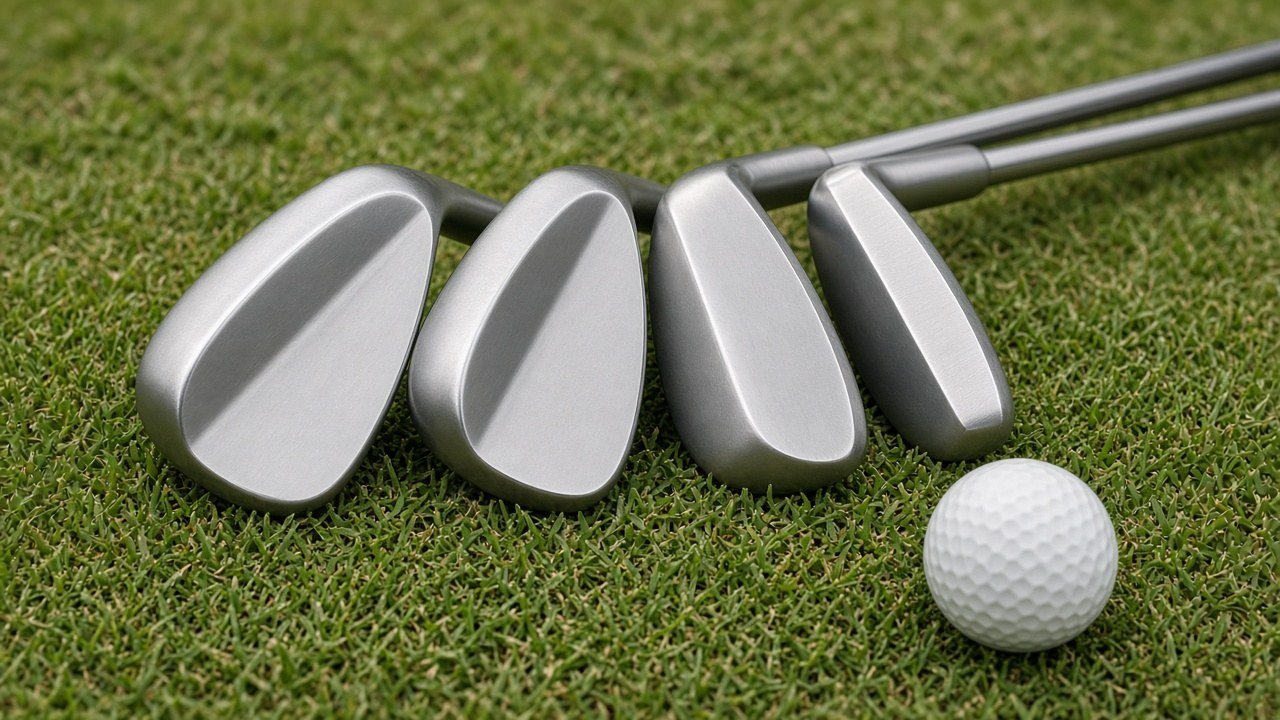
The four wedges
Takeaway: Each wedge covers a band of distances; together they cover everything inside a full pitching wedge.
| Wedge | Typical loft | Example (PING) | Main job |
|---|---|---|---|
| Pitching wedge (PW) | 42°–46° | PING G440 PW: 42° | Full shots, longer chips and pitches |
| Gap / approach / utility wedge | 47°–52° | G440 UW: 47°; s159: 50°, 52° | Fills the distance gap between PW and SW |
| Sand wedge (SW) | 54°–56° | s159: 54° and 56° in several bounces | Bunkers, pitches, chips that need height |
| Lob wedge (LW) | 58°–60°+ | s159: 58° and up | High, soft shots over hazards |
Titleist's 2026 Vokey SM11 range spans 44° to 60° across six grinds, so every one of these slots can be filled from a single wedge line; see our Vokey SM11 review.
Bounce in plain English
Takeaway: Bounce is what lets a wedge skim instead of dig.
Bounce angle is the angle between the leading edge and the lowest point of the sole. With more bounce, the trailing part of the sole hits the ground first and the club glides through sand or soft turf. With less bounce, the leading edge sits closer to the ground, which helps on firm turf and tight lies but digs more easily. Wedge names often include it: PING's "56/W-14" is a 56° wedge with 14° of effective bounce, while "56/H-10" has 10°.
| Bounce | Suits | Beginner note |
|---|---|---|
| Low (about 4°–8°) | Firm turf, shallow swings, open-face shots | Unforgiving if you hit behind the ball |
| Mid (about 9°–12°) | Most conditions | A safe default |
| High (about 13°+) | Soft sand, lush turf, steep swings | Most forgiving in bunkers |
The bands are general guidance used across the industry, not a rule. Our bunker guide shows how bounce helps in practice.
What is a grind?
A grind is material removed from the sole, usually at the heel, toe or trailing edge, to change how the wedge sits when you open the face. Vokey uses letters (F, S, M, D, K and T on SM11), and each suits a different swing and turf type. Beginners can ignore grinds at first: pick a full-sole, mid- or high-bounce option and learn square-face shots.
How many wedges should a beginner carry?
Takeaway: Two or three: PW, one gap wedge and a sand wedge.
Modern game-improvement pitching wedges are strong. A 42° PW followed by a 56° SW leaves a 14° gap, which often means 25–30 yards with no full-swing club. A 50°–52° gap wedge fixes it. Add a lob wedge only after your sand wedge contact is consistent. For the full bag layout, see how many clubs in a golf bag and the golf club loft chart.
Three wedge set-ups, by player
| Player | Set-up | Gaps |
|---|---|---|
| Beginner, strong-lofted irons | PW 42° · 48° · 54° high bounce | 6°, 6° |
| Beginner, traditional irons | PW 45°–46° · 52° · 56° | 6°–7°, 4° |
| Improving | PW · 50° · 54° · 58° | About 4° each |
What tour players carry
Most pros carry three or four wedges, often ending at 58° or 60°, and pick grinds for each course. You can see exact wedge lofts and grinds player by player in our pro WITB guide. Their set-ups make sense for players who hit full wedges with precise distance control; beginners gain more from fewer wedges they trust.
Build your own wedge distance chart
Takeaway: Three swing lengths with three wedges gives you nine distances to rely on.
Distances vary too much between golfers for a generic chart to help, so make your own. On a range with flags or a launch monitor, hit five balls with each wedge at three swing lengths: hands to hip height, hands to chest height, and a full swing. Write down the average carry of each set and ignore the worst ball. You end up with a small grid like this:
| Wedge | Hip-high swing | Chest-high swing | Full swing |
|---|---|---|---|
| Pitching wedge | ___ yd | ___ yd | ___ yd |
| Gap wedge | ___ yd | ___ yd | ___ yd |
| Sand wedge | ___ yd | ___ yd | ___ yd |
Tape it inside your bag. If two boxes are within a few yards of each other, you have overlap; if there is a big jump, you have a gap to fix with loft or a new swing length. The method for the rest of the bag is in build your yardage chart. The ball matters too: a urethane-covered ball such as the Titleist Pro V1 spins more off wedges than a two-piece ionomer ball, so test with the ball you play.
Wedge buying checklist
- Check your pitching wedge loft first (maker's spec page)
- Choose wedge lofts that keep gaps at 4°–6°
- Sand wedge: mid or high bounce unless your bunkers are firm
- Same shaft family as your irons
- Look at groove wear on used wedges; worn grooves spin less
Common beginner mistakes
- Buying a 60° first. It is the hardest wedge to hit well.
- Low-bounce sand wedge in soft sand. It digs.
- Ignoring the PW loft. Your gap wedge choice depends on it.
- Only full swings at the range. Most wedge shots are partial swings; practise half and three-quarter shots too (see chipping vs pitching).
- Old wedges with worn grooves. Spin and control drop.
Frequently asked questions
What degree is a pitching wedge?
Usually 42°–46° in modern sets. PING's G440 pitching wedge is 42°.
What degree is a sand wedge?
Typically 54°–56°.
What is bounce on a wedge?
The angle of the sole that keeps the leading edge from digging. More bounce suits soft sand and steep swings.
How many wedges should a beginner carry?
Usually three: a pitching wedge, a gap wedge and a sand wedge.
Do I need a lob wedge?
Not at first. Learn with a sand wedge and add a lob wedge once your contact is consistent.