
Why generic distance charts mislead you
Takeaway: Your 7-iron distance is only meaningful next to your 7-iron's loft and your swing speed.
Charts that say "a 7-iron goes 150 yards" ignore three things. First, lofts vary: PING alone offers its G440 7-iron at 27.5°, 29° or 31°. Second, swing speeds vary hugely between golfers. Third, beginners' strikes vary from shot to shot, so a single "best" number is misleading. Your own chart, built from your own clubs, fixes all three.
What to measure: carry vs total
| Number | Meaning | Use it for |
|---|---|---|
| Carry | Distance in the air before the first bounce | Choosing clubs over bunkers, water and onto greens |
| Total | Carry plus roll | Tee shots and planning lay-ups on firm ground |
| Spread | Gap between your shorter and longer typical shots | Knowing how much margin to leave |
Takeaway: Plan approach shots with carry; most amateurs' misses finish short of the hole.
Our 10-ball method
- Warm up for 10 minutes so the numbers reflect your normal swing.
- Use a launch monitor or a range with known flag distances. On a grass range, note where balls land, not where they stop.
- Hit 10 balls with one club at your normal, comfortable swing.
- Remove the two longest and two shortest.
- Average the remaining six for your typical carry, and note the shortest and longest of those six as your spread.
- Repeat for each club over one or two sessions, using the ball you play on the course.
- Re-test each season, or after any club or swing change.
Laying alignment sticks down for every shot keeps aim consistent so you measure distance, not direction errors; see our alignment stick guide.
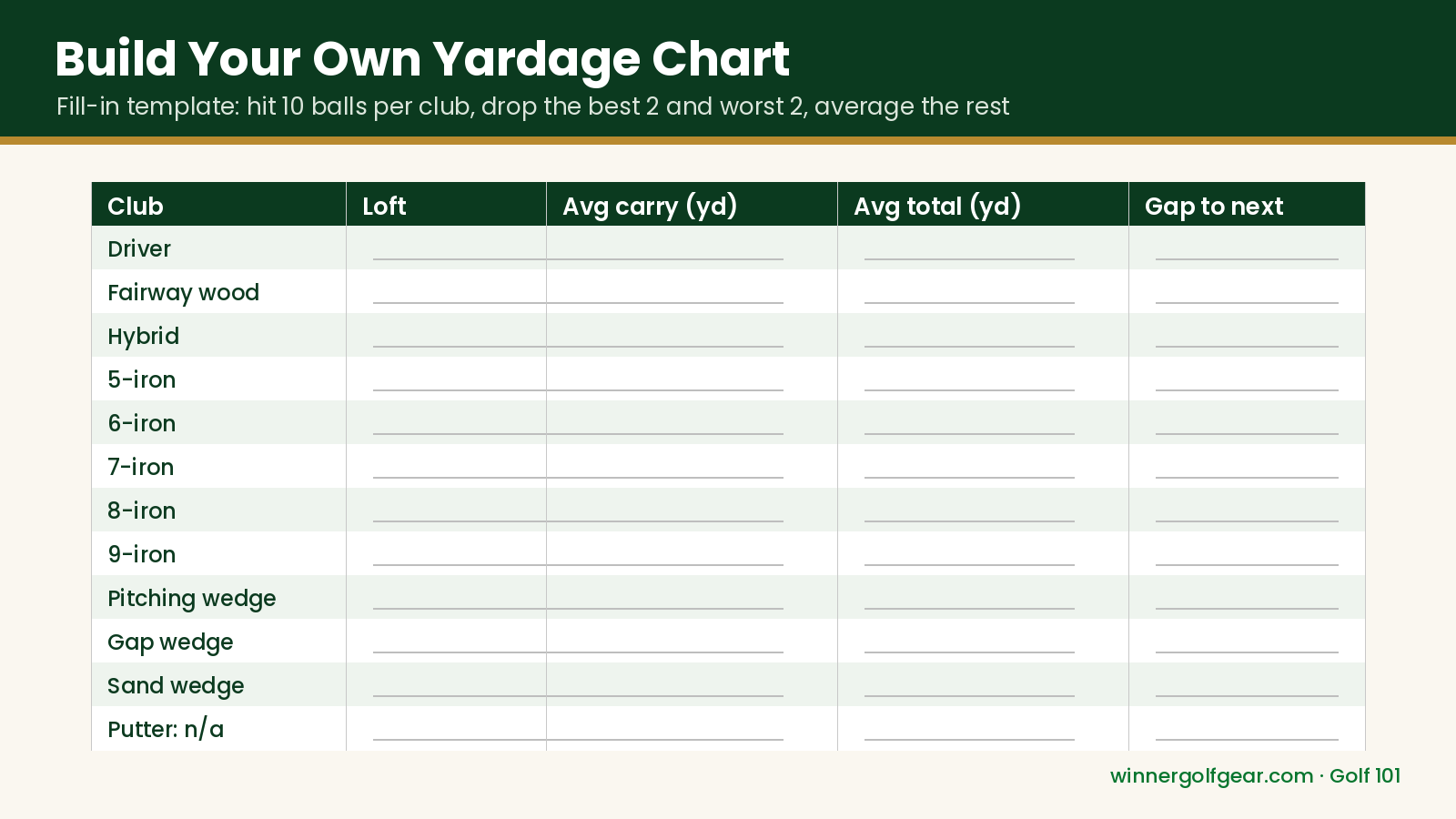
Your fill-in yardage chart
| Club | Loft (from maker) | Typical carry | Spread (short–long) | Gap to next club |
|---|---|---|---|---|
| Driver | ___° | ___ yd | ___–___ | ___ |
| Fairway wood | ___° | ___ yd | ___–___ | ___ |
| Hybrid | ___° | ___ yd | ___–___ | ___ |
| 6-iron | ___° | ___ yd | ___–___ | ___ |
| 7-iron | ___° | ___ yd | ___–___ | ___ |
| 8-iron | ___° | ___ yd | ___–___ | ___ |
| 9-iron | ___° | ___ yd | ___–___ | ___ |
| Pitching wedge | ___° | ___ yd | ___–___ | ___ |
| Gap wedge | ___° | ___ yd | ___–___ | ___ |
| Sand wedge | ___° | ___ yd | ___–___ | ___ |
Look up each loft on the maker's spec page; our golf club loft chart shows a full loft ladder for reference.
Reading your chart: three patterns
Takeaway: The chart's real value is in what it tells you to change.
| Pattern | What it means | What to do |
|---|---|---|
| Two clubs carry about the same | Overlap: one is wasted | Drop one; usually keep the easier-to-hit club (often the hybrid) |
| Gaps get bigger at the long end | Long clubs don't launch high enough | Consider more loft, a hybrid or a higher-launch shaft |
| Big jump between PW and SW | Wedge loft gap | Add a gap wedge (see golf wedges explained) |
| Driver barely longer than fairway wood | Driver loft or strike issue | Check loft vs speed in our driver loft guide |
No launch monitor? Use the course
Many courses have yardage markers, sprinkler-head distances or a GPS app. On quiet evening rounds, hit two balls into a par 3 with the same club and note where they land relative to the flag distance. Over a few weeks you'll have a reliable carry for your mid-irons. Rangefinders and GPS devices are allowed for distance under the Rules unless a local rule prohibits them, though using a device to measure elevation changes or get club recommendations is not allowed during a round (Rule 4.3a).
Partial-swing numbers for scoring clubs
Takeaway: Inside 100 yards, knowing two or three swing lengths per wedge is worth more than another full-swing number.
Once your full-swing chart is done, add partial swings for your wedges and 9-iron: a hip-high swing and a chest-high swing, measured the same way (10 balls, drop the extremes, average the rest). Most strokes for beginners are lost around and inside 100 yards, so these are the distances you will use most. Our golf wedges explained page has a ready-made grid for them. Write the numbers on a card you keep in your bag rather than in a phone you will not check mid-round.
How the pros use theirs
Tour players know their carry numbers for every club and several partial swings, and they build bags around even gaps; you can see the result in the lofts listed on our pro WITB pages. You don't need that level of detail; a chart with one number per club is a big step up from guessing.
Common beginner mistakes
- Using your best-ever shot as your number. Use the typical one.
- Measuring total distance on a firm range and using it to carry hazards.
- Testing with range balls that fly differently from your own ball.
- Not re-testing after changing clubs or improving your swing.
- Choosing clubs to reach the flag with a perfect strike. Pick the club whose typical carry reaches the middle of the green.
Frequently asked questions
How far should I hit each golf club?
It depends on your swing speed, strike and the lofts in your set. Build your own chart by averaging your typical carry with each club.
What is the difference between carry and total distance?
Carry is the distance in the air; total includes roll. Use carry for approach shots and hazards.
How many yards should be between each iron?
Most golfers see roughly even steps between irons. If two clubs carry the same, one is wasted; if a gap is very large, adjust loft or add a club.
Can I use a rangefinder in golf?
Yes, for measuring distance, unless a local rule bans them. Functions like slope are not allowed in competitions.
How often should I update my yardage chart?
At least once a season, and after any club or swing change.