
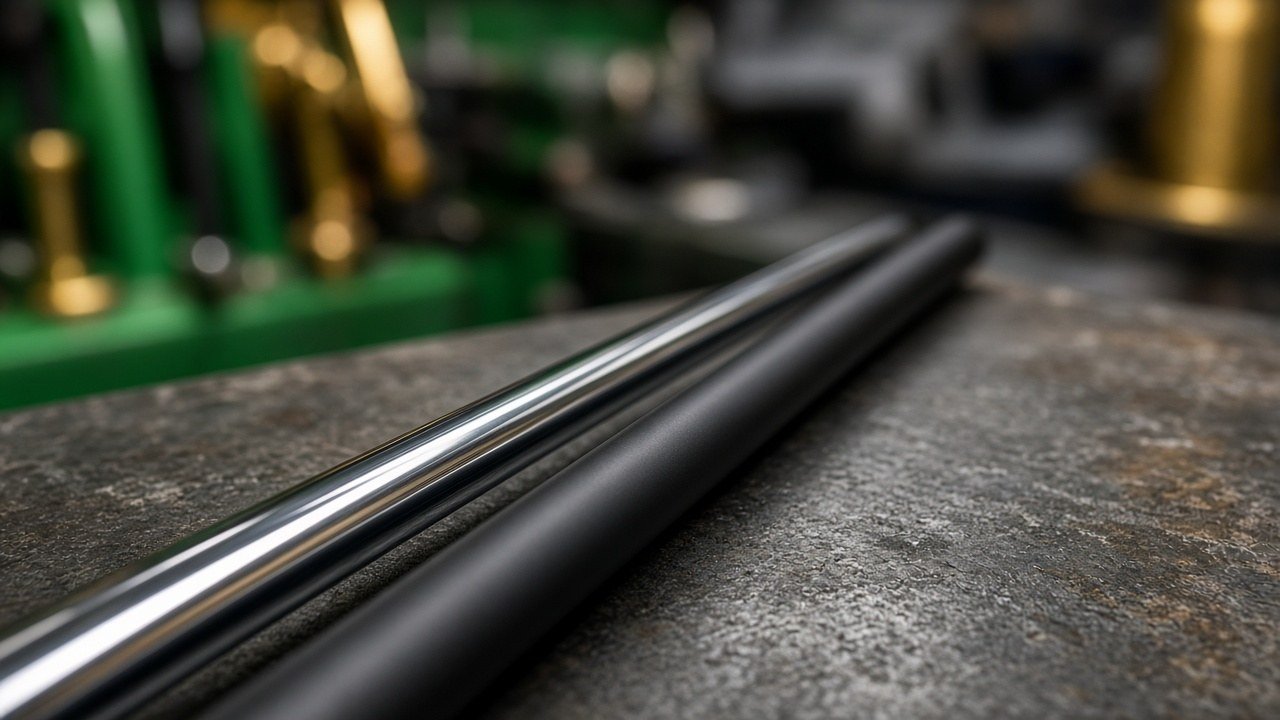
The short comparison
Takeaway: Choose graphite irons if speed or comfort is the issue; choose steel if control and budget matter more.
| Graphite | Steel | |
|---|---|---|
| Weight | Lighter | Heavier |
| Feel | Dampens vibration; kinder on sore joints in cold weather | More feedback from the strike |
| Typical launch | Often higher at the same speed | Often a little lower |
| Cost | Usually higher in irons | Usually lower |
| Where you find it | Nearly all drivers, woods and hybrids; many senior, women's and game-improvement irons | Most stock iron and wedge sets; most putters |
| Best for | Slower swings, joint or elbow pain, players who want more height | Average to fast swings, players who want lower, tighter flight |
What the weights look like on real clubs
Takeaway: Shaft weight climbs as clubs get shorter: driver shafts are the lightest in the bag.
PING publishes shaft weights for its stock shafts, which gives a clear picture across one family of clubs:
| Club | Stock shaft | Weights by flex |
|---|---|---|
| G440 Max driver | PING ALTA CB Blue 50 (graphite) | Soft Regular 49 g · Regular 51 g · Stiff 55 g |
| G440 Max driver (option) | PING Tour 2.0 Chrome 65 (graphite) | Regular 56 g · Stiff 61 g · X-Stiff 66 g |
| G440 Max fairway | PING ALTA CB Blue 65 (graphite) | Soft Regular 56 g · Regular 58 g · Stiff 62 g |
| G440 hybrid | PING ALTA CB Blue 70 (graphite) | Soft Regular 69 g · Regular 73 g · Stiff 76 g |
For irons, PING notes that standard swingweights for graphite-shafted clubs are 2 to 3 points lighter than its steel figures, a direct sign of the lighter build. Heavier steel iron shafts are a big part of why a set of steel irons feels "heavier" in the hands.
Flex matters as much as material
Flex (Ladies, Senior/A, Regular, Stiff, X-Stiff) controls how much the shaft bends during the swing. Our driver shaft flex guide lists swing-speed bands from two manufacturer charts: Regular at about 85–95 mph driver speed and Stiff at about 95–105 mph. A graphite shaft in the wrong flex is still the wrong shaft.
What tour players use, and why it doesn't decide it for you
Takeaway: Pros use heavier, stiffer shafts because they swing much faster; the material is not the point.
Every driver in our Tour Bag Index uses a graphite shaft, and most are 60-gram-class shafts in X or TX flex. Their irons are mostly steel. That combination suits swing speeds well above most amateurs'. A beginner copying it ends up with shafts too heavy and too stiff to launch the ball well. The pro WITB guide explains how to read shaft names like "Ventus Black 7 X".
Our decision guide for iron shafts
| If this describes you… | Start with |
|---|---|
| Driver carry under about 180 yards, or joint/elbow pain | Graphite irons, Senior or Regular flex |
| Driver carry roughly 180–230 yards, no pain | Try both: light steel vs graphite in Regular |
| Fast swing, ball flight too high | Steel, Stiff (get fitted) |
| Not sure | Hit a 7-iron with each on a launch monitor and compare carry and dispersion |
The carry-distance bands here are our rough guidance for choosing what to test first, not a fitting standard.
Shaft weight, tempo and fatigue
Takeaway: The right weight is the one you can swing at the same tempo on the 18th hole as on the 1st.
Weight affects more than speed. A shaft that is too heavy can slow your swing and tire you out over a round, especially if you walk. One that is too light can make your tempo quick and your strike inconsistent. Put simply: a lighter shaft may add head speed, a heavier one may tighten dispersion. A useful test is to hit a few balls with each option at the end of a range session, when you are tired, and see which one you still strike well. Keeping weights steady through the bag matters too: shaft weight typically steps up from driver to fairway to hybrid to iron, as PING's stock weights show, and a sudden jump between two neighbouring clubs is easy to feel.
Myths worth dropping
- "Graphite is only for seniors." Every tour driver uses graphite; plenty of strong players use graphite irons too.
- "Steel is always more accurate." Accuracy depends on the weight and flex being right for your swing, not the material.
- "Graphite breaks easily." Modern graphite is durable; scratches on the shaft from bag rattle are the main thing to watch on used clubs.
Buying used? Check these
- Flex marking on the shaft band matches what you want
- No deep scratches, cracks or splintering near the hosel (graphite)
- No rust pitting or bends (steel)
- Same shaft type through the whole iron set
- Length checked against your height (club length calculator)
Common beginner mistakes
- Buying Stiff "to grow into". It lowers launch and feel now.
- Heavy steel irons with a very light graphite driver without trying them together; big weight jumps can upset tempo.
- Judging by the label. One brand's Regular can play like another's Stiff.
- Ignoring pain. If your elbows ache after range sessions, graphite irons are worth testing.
- Re-shafting cheap old clubs. The cost can exceed the value of the club; a newer used set may be better value.
Frequently asked questions
Are graphite shafts better for beginners?
Often, especially for slower swings or anyone with joint pain, because graphite is lighter and dampens vibration. Faster swingers may control steel irons better.
Do pros use graphite or steel shafts?
Graphite in drivers and woods, and mostly steel in irons and wedges.
Is graphite or steel more accurate?
Neither by default. Accuracy comes from the right weight and flex for your swing.
How much does a graphite driver shaft weigh?
Stock graphite driver shafts are commonly around 50–65 g. PING's ALTA CB Blue 50 is 49–55 g depending on flex.
Should my irons and wedges have the same shaft?
Usually wedges use the same material as the irons, sometimes slightly heavier, so the feel stays consistent.